4 Documents to Bring to an IEP Meeting and What to Say

Bring the current IEP or draft, recent evaluations, progress reports, a short list of your top priorities and questions, and a notepad. The single most useful step is requesting the draft IEP ahead of time and emailing your top three priorities to the case manager before the meeting, a right supported by federal parent participation rules, and a task tool like IEPful’s Plan Builder can help organize.
TL;DR:
- Bringing a draft IEP, recent evaluations, progress reports, and work samples helps parents verify that goals and services are accurate and measurable.
- Organizing a one-page list of three priorities and emailing it beforehand ensures the team addresses key concerns with prepared responses.
- Inviting knowledgeable participants like advocates, outside providers, or a translator can clarify complex goals and facilitate communication during the meeting.
- Reviewing each document with specific questions about accuracy, recent scores, and relevance prepares parents to advocate effectively during discussions.
- Using a personalized plan tool like IEPful’s Plan Builder streamlines meeting preparation, follow-up, and tracking changes to promote effective participation.
Table of Contents
- Quick checklist: documents, samples, tech, and day-of essentials
- Document-by-document guide: what to check in each paper
- Who to bring and how each person helps the meeting
- Before the meeting: step-by-step prep
- During the meeting: participation, notes, and disagreements
- After the meeting: confirming outcomes and next steps
- Turning this checklist into a plan with IEPful
- Sources
- FAQ
Quick checklist: documents, samples, tech, and day-of essentials
Print this list or adapt it before packing your binder.
Documents to bring:
- Current IEP or the draft sent by the school.
- Recent evaluation reports and any private evaluations you have obtained.
- Progress reports, report cards, and related-service provider notes.
- Medical or therapy reports if relevant to classroom performance.
Evidence and proof of progress:
- Several work samples that show growth or ongoing struggle.
- Behavior logs or attendance notes if either affects services.
Tools and copies to pack:
- A binder or folder organized by document type.
- Labeled copies of key documents to hand to the team.
- A notepad, two pens, and a charged phone.
- A printed copy of any email you sent the case manager beforehand.
Day-of logistics matter too. Confirm the list of attendees in advance, bring contact information for each team member, pack water or a snack if the meeting runs long, and confirm any interpreter request has been received. Plan for a short break if the conversation gets tense or technical.
Document-by-document guide: what to check in each paper
Each document does a different job in the meeting, so review each one with a specific question in mind.
- Current IEP or draft: Check that present levels describe your child accurately, that annual goals are measurable, and that services, accommodations, and how progress will be reported are spelled out. Federal guidance requires that an IEP state how progress toward each goal will be measured and reported.
- Evaluations and assessments: Note the testing date, how scores compare to prior results, and what methods produced the recommendations.
- Progress reports and work samples: Line these up against current IEP goals so you can point to a specific example during discussion.
- Medical, therapy, or behavior reports: Bring a short written note on how the diagnosis or plan shows up in the classroom, not just the clinical language.
Pro Tip: Sticky-flag the page in each document where you want the team to focus, so you are not flipping through pages while the conversation moves on.
Who to bring and how each person helps the meeting
Under IDEA’s parent participation rule, parents may invite anyone with knowledge or special expertise about their child, including an advocate, a private therapist, a family member, or a translator. If your family needs an interpreter, request one in writing early since scheduling guidance confirms schools must arrange this when needed.
- An advocate can help track discussion points and flag when a proposal does not match the data.
- An outside provider can speak directly to therapy goals or a diagnosis the school team has not observed firsthand.
- A student old enough to weigh in can attend part of the meeting, especially when transition planning is on the agenda.
- Notify the school ahead of time who is coming and share your short agenda so no one is caught off guard.
Before the meeting: step-by-step prep
A little organization the week before changes how the whole meeting feels.
- Request the draft IEP and any recent evaluations in writing. Parents have a right to inspect and review education records, and schools must respond without undue delay and no later than 45 days.
- Write a one-page parent priorities list. Keep it to three items, such as “increase reading fluency support,” “clarify speech therapy frequency,” and “address recess behavior incidents.”
- Email that list to the case manager about a week ahead so the team can prepare responses instead of reacting cold.
- Assemble your binder, make copies for each team member, and highlight sections where you want discussion.
- Draft one or two suggested goals or accommodations you would like the team to consider, with a work sample attached as support.
Pro Tip: A short, specific priorities list gets read. A long one often gets skimmed and loses its impact.
During the meeting: participation, notes, and disagreements
Open the meeting by stating your top priorities out loud, then support each one with a specific example from your binder. When the team proposes a service level or goal, ask what data supports it and request a measurable change if the current language feels vague.
- Assign one person, yourself or a support person, to take notes so you can stay focused on the conversation.
- Ask for copies of any data the school references during discussion.
- Request a short pause if the conversation moves faster than you can process.
Recording rules vary by state, so notify the school before recording and consider requesting detailed written notes or prior written notice as an alternative when recording is not an option.
After the meeting: confirming outcomes and next steps
Ask for the final signed IEP copy, which schools must provide at no cost to parents, along with a timeline for when you will receive it.
- Send a short follow-up email summarizing what you understood was agreed to.
- Request prior written notice for any proposed change, refusal, or denial of services.
- If you disagree with the outcome, ask about mediation or due process options and look up your local Parent Training and Information Center for guidance.
- Set a reminder to check in on progress reports at the interval the IEP specifies.
Turning this checklist into a plan with IEPful
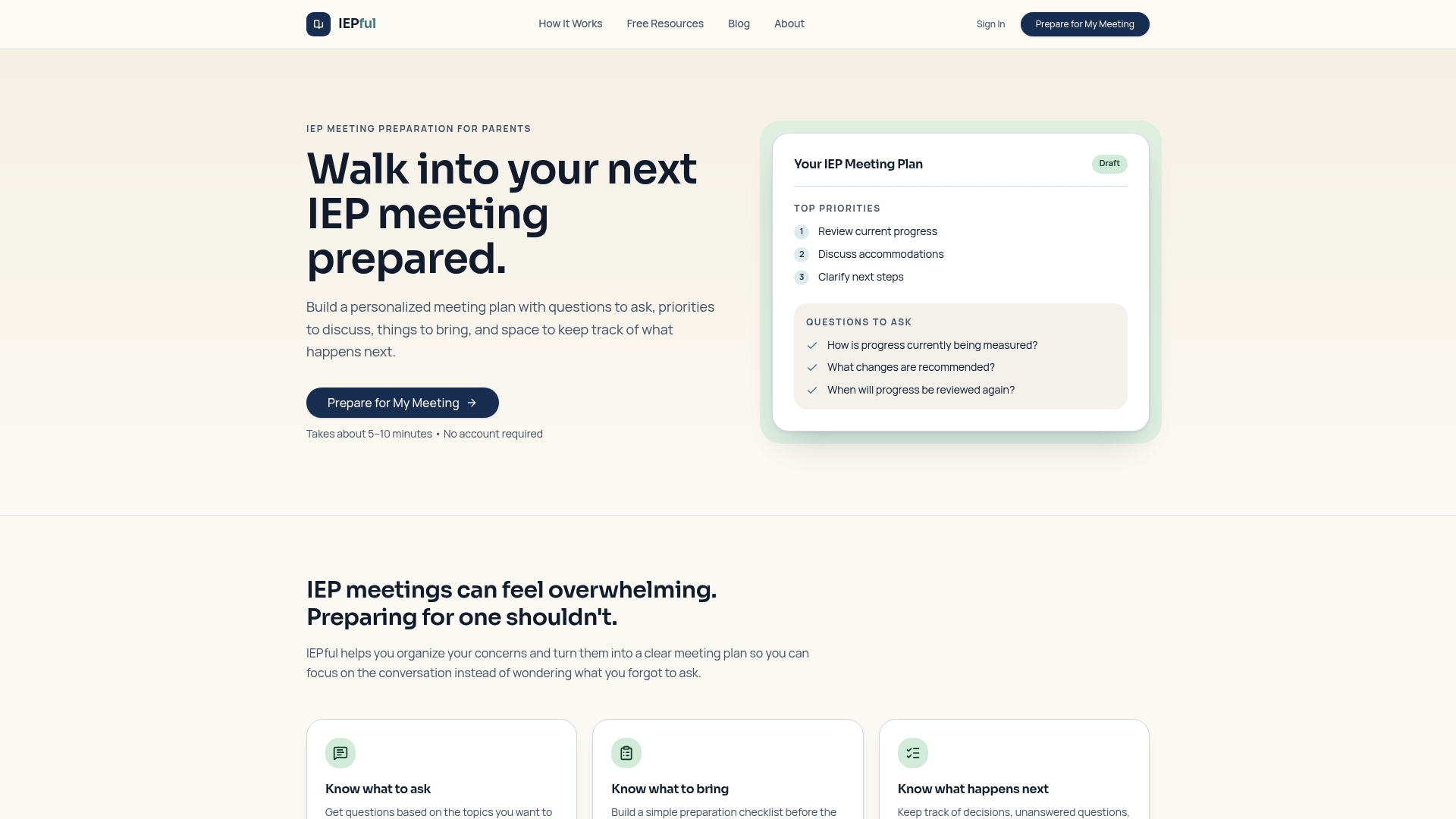
Reading a checklist is one thing. Turning it into a finished agenda, a labeled set of priorities, and follow-up notes the night before a meeting is another. IEPful’s free Plan Builder walks you through your child’s situation and produces a personalized meeting plan without requiring an account, so you are not starting from a blank page.
- Build: Answer a few questions and get a plan organized around your priorities.
- Print: Use the plan alongside the binder and document checklist above.
- Track: Note decisions and follow-up items during and after the meeting.
Parents who want more structure can add the optional Complete Meeting Pack for $19, which includes expanded questions, printable materials, note-taking pages, and follow-up tracking. Start at IEPful or see how the tool works before you build your plan.
Sources
- Sec. 300.322 - Parent participation (IDEA regs)
- IEP components: goals and progress reporting (IRIS Center / Vanderbilt)
- Scheduling the IEP meeting and notifying parents (Center for Parent Information and Resources / Parent Center Hub)
FAQ
What not to say during an IEP meeting?
Avoid vague statements like “he’s just lazy” or agreeing to something on the spot that you have not had time to review. It is fine to say you need time to think about a proposal before signing.
What are the 13 disabilities required for an IEP?
IDEA lists specific disability categories, including autism, specific learning disability, speech or language impairment, and other health impairment, among others. A school district or state education agency can confirm which category applies to your child’s evaluation.
What do you wear to an IEP meeting?
There is no dress code. Comfortable, casual clothing is appropriate since the focus is on the conversation, not appearance.
What is a parent supposed to do in an IEP meeting?
Parents are expected to participate as a full member of the IEP team, sharing observations about their child and reviewing proposed goals and services. Federal rules guarantee parents an opportunity to participate in every decision about their child’s plan.
Recommended
Created with BabyLoveGrowth to build website authority
IEPful provides educational planning and organization information, not legal, medical, or individualized professional advice. Requirements and procedures can vary; verify current information with official sources.