5 Questions Parents Should Ask About IEP Goals and What Each Reveals

The strongest IEP meetings come down to five question areas: whether each goal is measurable, how progress will be tracked and reported, which services and supports back it up, what data and classroom samples support the present levels, and what happens if progress stalls. A goal worth signing has a clear criterion, a monitoring schedule, a named responsible staff member, and an agreed plan for revision.
TL;DR:
- IEP goals should have clear, measurable criteria and specify how and when progress will be tracked and reported, not just general objectives.
- Parents should request current evaluations, classroom samples, and clear data before the meeting to identify gaps and prioritize concerns effectively.
- During the meeting, ask detailed questions about present levels, goal measurement, services, accommodations, behavior, and transition planning, ensuring clarity and accountability.
- If progress stalls, the team is required to review and revise the IEP promptly, and parents can request interim meetings or amendments outside the annual review.
- Using an organized meeting plan or checklist helps parents focus on key questions, document responses, and follow up on agreed actions to support ongoing progress.
Table of Contents
- Questions to ask before the IEP meeting: logistics and documents to request
- Questions to ask during the IEP meeting: present levels, goals, and services
- How to judge whether an IEP goal is actually well written
- If goals aren’t being met: questions about revisions and next steps
- How a meeting planner helps: organizing questions, notes, and follow-ups
- How parents and providers can work together outside the meeting
- Advocating for goal changes when your child’s needs shift
- Do IEP goals connect to state standards and outcomes?
- What are your legal rights around IEP goals and your input?
- Turn your questions into a meeting plan with IEPful
- Sources
- FAQ
Questions to ask before the IEP meeting: logistics and documents to request
A focused meeting starts days before anyone sits down at the table. Requesting the right paperwork early gives you time to spot gaps in present levels, check whether last year’s goals were met, and walk in with two or three priorities instead of a dozen scattered concerns.
- Ask for a current copy of the IEP, recent evaluations, and progress data on existing goals before the meeting.
- Request samples of your child’s classwork tied to the goals under discussion.
- Ask for the meeting agenda and a list of who will attend, including who will present evaluation results.
- Share your top two or three concerns in writing ahead of time so the team can prepare responses.
- Confirm the meeting format and any accessibility needs, such as a remote link or interpreter.
A short script helps here: “Could you send me the most recent progress data and a work sample before we meet, so I can review them ahead of time?” Another useful line: “Who on the team will walk us through the evaluation results?” Naming the person in advance avoids a meeting where nobody feels responsible for explaining the numbers.
Questions to ask during the IEP meeting: present levels, goals, and services
Once you’re in the room, the goal is to get specific answers, not general reassurance. Categorize your questions so you cover present levels, goal wording, measurement, services, accommodations, and, where relevant, behavior and transition planning.
- Present levels. Ask for the data behind the description: “What test scores, work samples, or classroom observations show how my child is doing right now, and how does the disability affect access to grade-level material?”
- Goal wording. For each proposed goal, ask: “What exactly will my child do, under what conditions, how will you measure it, and what score or result counts as mastery?”
- Measurement schedule. Ask: “What tool will you use to collect data, how often, and when will I receive a progress report?” Under IDEA’s regulations on IEP content, every IEP must describe how progress will be measured and when periodic reports will go out, so this is not an optional detail for the team to skip.
- Services and delivery. Ask: “Who provides this service, where does it happen, how often, and what training does that staff member have?”
- Accommodations. Ask for concrete examples: “What does this accommodation look like on a test, during homework, or in seating arrangements, and when does it apply?”
- Behavior goals. Ask: “Is this a replacement behavior we’re teaching, how will you measure it, and what data will you collect on both the target behavior and the behavior it’s meant to replace?” Guidance on behavioral goal development notes that behavioral IEP goals should target observable replacement behaviors and be monitored frequently using objective methods so the team can tell quickly whether the plan is working.
- Transition planning (for older students). Ask: “What are the measurable postsecondary goals, and when did transition planning officially start for my child?”
Pro Tip: Ask the team to restate any goal in plain language and give one real classroom example of what meeting it would look like. If they can’t, the goal probably isn’t specific enough yet.
These questions work best asked one at a time, with a pause for the answer. A team member who can’t answer “how will you measure it” on the spot may need to bring that detail back in writing, and that’s a reasonable thing to request.
How to judge whether an IEP goal is actually well written
A quick SMART check helps you sort strong goals from vague ones without needing a background in special education law.
- Specific: The goal names an observable behavior, not a feeling or a general trend. “Sam will identify the main idea in a grade-level passage” is specific; “Sam will improve reading comprehension” is not.
- Measurable: There’s a number or rate attached, like “with 80% accuracy across 4 out of 5 trials,” rather than “will show growth.”
- Attainable: The target is a reasonable stretch from current performance, not a jump the data doesn’t support.
- Relevant: The goal connects to the present levels and the skills your child actually needs.
- Time-bound: The goal states when it will be measured, typically within the annual IEP period, with checkpoints along the way.
A nonexample: “Jordan will behave appropriately in class.” A stronger version: “Jordan will raise his hand and wait to be called on before speaking, in 4 out of 5 observed opportunities, as measured by teacher tally over two consecutive weeks.” Three quick checks apply to almost any goal: is the behavior observable, is there a concrete mastery criterion, and are the conditions or settings clearly stated?
You’ll likely hear terms like DBR (Direct Behavior Rating), trial-based data, or percent accuracy. Each just describes a different way of counting: DBR rates behavior on a simple scale during a set period, trials count correct responses out of attempts, and percent accuracy compares correct answers to total opportunities. None is inherently better; what matters is whether the method matches the skill being measured.
IDEA requires that every IEP include a description of how the child’s progress toward annual goals will be measured and when periodic progress reports will be provided to parents. This comes directly from federal special education regulations, and it means “we’ll let you know how it’s going” is not a sufficient answer from the team.
If goals aren’t being met: questions about revisions and next steps
Federal regulations require IEP teams to review and revise a child’s IEP when the child is not making expected progress toward annual goals, so a stalled goal is not something parents have to just wait out. IDEA’s rules on IEP review and revision put that responsibility on the team, not solely on the parent to notice and push.
- Ask: “What data shows progress or the lack of it since the last report?”
- Ask: “When can we meet again, and what changes to instruction or services will we try in the short term?”
- Ask how to request an interim meeting or a written IEP amendment rather than waiting for the annual review.
- Put your concerns in writing, even a short email, so there’s a dated record of when you raised the issue.
- Ask for a follow-up date in writing before the meeting ends.
You don’t have to wait for the annual review if things aren’t working. Parents can request an IEP meeting at any point when a child isn’t making expected progress or when circumstances change.
How a meeting planner helps: organizing questions, notes, and follow-ups
Turning a long question list into something usable during a 30-minute meeting is its own challenge. A free Plan Builder helps by taking your priorities and turning them into a printable, organized checklist, no account required.
- Capture your top concerns and get relevant questions generated automatically.
- Get a printable checklist you can bring straight into the meeting.
- Optional meeting packs can include expanded questions, printable materials, note-taking pages, and follow-up tracking.
Typical use: build your plan the night before, use the checklist during the meeting to keep questions on track, record agreed action items and deadlines as they come up, then print or export your notes to draft a follow-up email. The Plan Builder is designed around exactly this kind of before-during-after workflow.
How parents and providers can work together outside the meeting
IEP goals live in the classroom and the therapy room, but plenty of the work that supports them can happen at home too, if the team tells you what to reinforce. It’s reasonable to ask the teacher or service provider directly: “Is there anything I can practice with my child at home that matches what you’re working on in the goal?”
Ask specifically how they’ll keep you in the loop between formal progress reports. A quick weekly note home, a shared log, or a short check-in call can surface small problems before they become a stalled goal. Ask, too, whether there are materials or strategies the school uses that you could mirror at home, so your child isn’t relearning a skill two different ways.
For a service like speech therapy or occupational therapy, ask the provider directly what carryover activities they recommend and how you’d know if you were doing them the way the goal intends. Consistency between school and home often shows up in progress data faster than either setting alone, and it’s a fair thing to ask about even if your child’s IEP doesn’t explicitly require home practice.

Advocating for goal changes when your child’s needs shift
A goal that made sense in September doesn’t always fit by January. Kids progress faster than expected, hit a wall, or face new challenges, and the IEP is meant to flex with that.
You don’t need to wait for the annual review to raise this. Ask directly: “Given what we’re seeing at home or in recent evaluations, does this goal still match where my child is now?” If a goal was mastered early, ask whether it should be replaced with something more ambitious rather than left in place until the next annual meeting. If a goal seems out of reach, ask what data would support scaling it back to a more attainable step, and what the team’s process is for making that change official through a written amendment.
Framing the conversation around data, rather than a general sense that “something’s off,” tends to move things faster. Bring a specific example: a test result, a comment from a provider, a change in behavior at home. Ask who signs off on a modification and how quickly a change can take effect once the team agrees.
Do IEP goals connect to state standards and outcomes?
Parents sometimes assume IEP goals exist in their own separate track from what the rest of the class is learning. In practice, most goals are meant to connect back to grade-level expectations, even when a child is working on a modified version of that content.
It’s worth asking directly: “How does this goal relate to what my child’s grade-level peers are expected to learn this year?” and “If my child meets this goal, what does that mean for their access to the general curriculum?” The Department of Education’s guidance tied to the Endrew F. decision emphasizes that goals should be appropriately ambitious in light of a child’s circumstances, not simply the easiest target the team can measure.
Ask, too, how the school tracks whether meeting IEP goals is translating into broader outcomes, like grade promotion, standardized assessment participation, or readiness for the next school year’s coursework. A goal can be technically measurable and still disconnected from what actually matters for your child’s education if nobody is checking that bigger picture.
What are your legal rights around IEP goals and your input?
Parents are formal, equal members of the IEP team, not guests being informed of decisions already made. That means you have standing to ask questions, request changes, and expect a response, not just at the annual meeting but whenever concerns come up.
Reasonable questions include: “What is my right to request an IEP meeting outside the annual schedule?” and “If I disagree with a proposed goal, what’s the process for raising that formally?” You do not have to wait for the yearly review if your child is not making expected progress or if circumstances have changed. It also helps to ask what happens if the team and the parent can’t agree, since districts are required to have a process for resolving disagreements about IEP content.
Keep in mind that specific dispute resolution options and timelines vary by state, so a district representative or your state’s parent training and information center is a better source for the exact steps than a general guide. What stays consistent everywhere is that parent input is a required part of the process, not an optional courtesy.

Turn your questions into a meeting plan with IEPful
Reading through question lists is one thing; walking into a meeting with them organized by priority is another. A Plan Builder takes the categories covered here and turns them into a personalized, printable checklist in a few minutes, without needing an account.
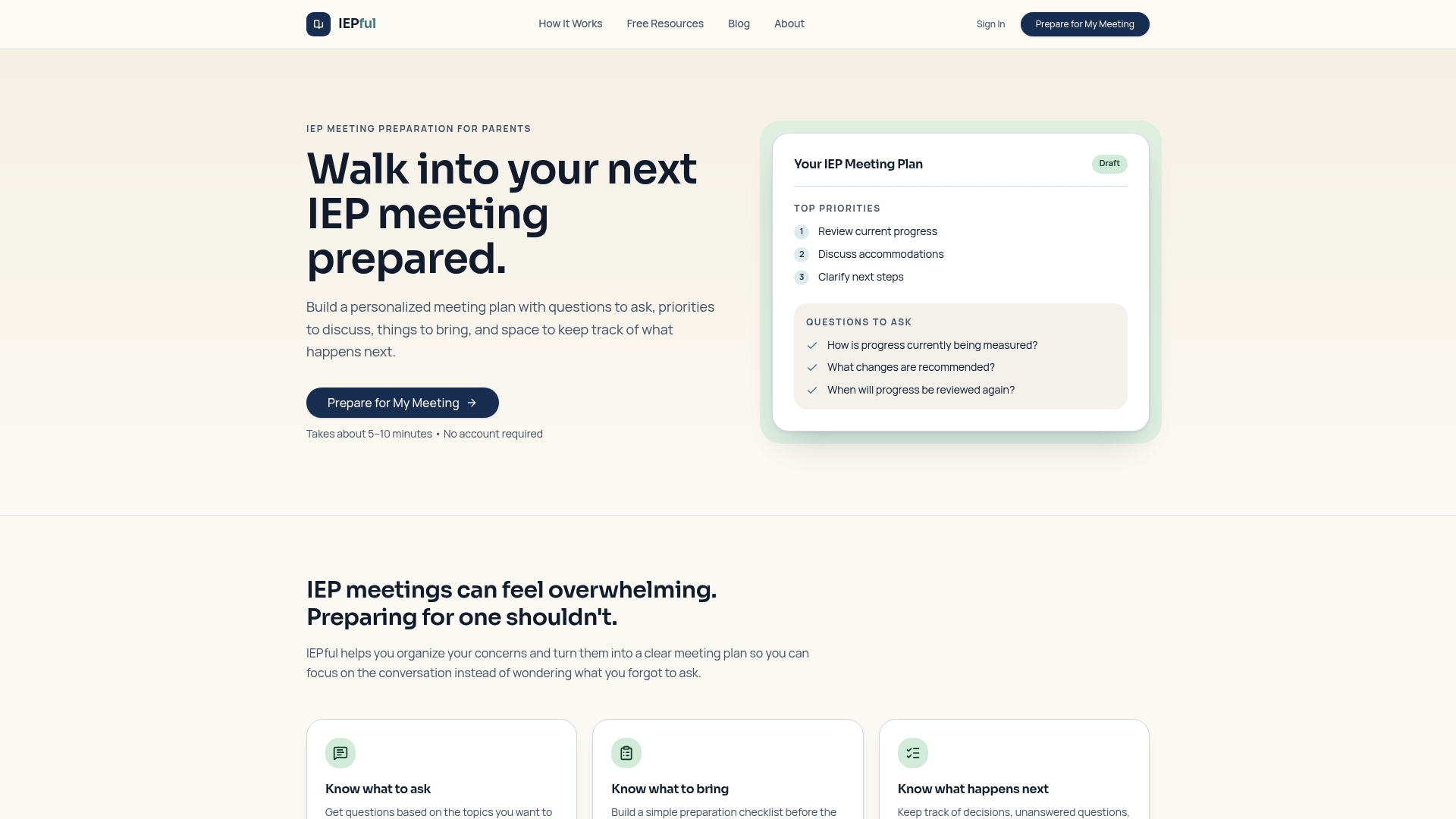 It suits parents who want a fast way to organize their concerns before a meeting rather than start from a blank page. If you want more, the optional $19 Complete Meeting Pack adds expanded questions, printable materials, note-taking pages, and follow-up tracking for parents who want a fuller record across multiple meetings.
Start with the free IEP Meeting Plan and walk into your next meeting with a checklist instead of a stack of loose notes.
Sources
- Sec. 300.320 Definition of individualized education program - Individuals with Disabilities Education Act
- Guidance on behavioral goal development and progress monitoring (ERIC/NCII source)
FAQ
What questions should a parent ask at an IEP meeting?
Focus on whether each goal is measurable, how and when progress will be reported, who delivers each service, and what data supports the present levels. Also ask what happens if progress stalls before the next review, since federal rules require the team to revisit goals when a child isn’t progressing as expected.
What are some good questions to ask about IEP goals specifically?
Ask what the child will do, under what conditions, how it will be measured, and what score or result counts as mastery. It also helps to ask for a specific example of what meeting the goal would look like in the classroom.
What should parents do when IEP goals are not being met?
Ask for the data showing lack of progress, request an interim meeting or written amendment rather than waiting for the annual review, and put concerns in writing. Parents can request an IEP meeting at any time if a child is not making expected progress, rather than waiting for the scheduled annual review.
Is an IEP only for children with autism?
No, an IEP is available to any student who qualifies for special education services under one of the disability categories defined by federal law, which includes autism but also covers many other disabilities. Eligibility depends on an evaluation showing the disability affects educational performance, not on any single diagnosis.
How often are IEP goals reviewed and progress reported?
IEP teams must review the IEP at least annually, but progress reports on goals typically go out more often, commonly alongside report cards, with the exact schedule stated in the IEP itself. Federal regulations require the IEP to specify when periodic progress reports will be provided, so parents should check that date rather than assume it matches the school’s general reporting calendar.
Written with BabyLoveGrowth AI
IEPful provides educational planning and organization information, not legal, medical, or individualized professional advice. Requirements and procedures can vary; verify current information with official sources.