Manifestation Determination: A 5 Step IDEA Checklist for U.S. Parents

A manifestation determination review is the IEP team meeting required when a school proposes to change a child’s placement for a disciplinary violation, and under federal regulation it must happen within 10 school days of that decision. The team asks two legal questions: was the behavior caused by the disability, or did the school fail to implement the IEP? A “yes” answer typically means a return to placement plus an updated behavior plan; a “no” answer allows discipline to proceed but educational services must continue.
TL;DR:
- A manifestation determination review is required when a child’s removal from placement exceeds 10 school days or involves a pattern of shorter removals totaling over 10 days, starting from the decision to change placement.
- The team must review documentation, including the child’s current IEP, discipline records, and outside evaluations, before answering two legal questions about whether the behavior is related to the disability or due to failure to implement the IEP.
- If the behavior is a manifestation, the school must conduct a functional behavioral assessment and implement or modify a behavior intervention plan, with the child returning to the original placement unless a different agreement is made.
- When the behavior is not a manifestation, disciplinary actions may proceed, but the school still must provide ongoing educational services and document the process thoroughly.
- In cases involving weapons, drugs, or serious injury, students can be placed in an interim alternative setting for up to 45 days without a manifestation review, but an MDR must still occur within 10 days.
Table of Contents
- When is an MDR required?
- Who must attend and what records should the team review?
- How the team applies the two-part legal test
- If the behavior is a manifestation, what happens next
- If the behavior is not a manifestation, what still applies
- Special circumstances: weapons, drugs, and serious injury
- A practical MDR preparation checklist
- How to challenge an MDR decision you disagree with
- What rights does the student have during the MDR process?
- How MDR differs from discipline for general education students
- The role of school psychologists and behavioral specialists
- Common challenges and disputes in the MDR process
- A quick guide to using IEPful before your MDR
- Sources
- FAQ
When is an MDR required?
Not every disciplinary incident triggers this meeting. The obligation kicks in when a school proposes a “change of placement,” which under IDEA’s regulations means a removal of more than 10 consecutive school days, or a pattern of shorter removals that add up to more than 10 school days in a school year. Once that threshold is reached, the 10-school-day clock for holding the MDR starts running from the date the school decided to change placement, not from the date of the incident itself.
Determining whether a series of short suspensions counts as a “pattern” requires looking at specific factors:
- The length of each removal and the total time the child has been removed so far.
- How close together the removals occurred during the school year.
- Whether the behavior leading to each removal was substantially similar across incidents.
One detail catches many families off guard: a child does not need a finalized IEP for these protections to apply. If the school district is “deemed to know” the child has a disability, for example because a parent had already requested an evaluation, the disciplinary protections, including the right to an MDR, can still apply according to OSEP guidance.
Who must attend and what records should the team review?
The meeting is not a one-person decision. IDEA requires the presence of specific people and specific documents before the team can reach a conclusion.
Required participants typically include:
- A representative of the local educational agency (LEA) with authority to make decisions.
- The parent or guardian.
- Other members of the IEP team the parent and LEA agree are relevant, chosen by both parties.
Records the team should review before forming a conclusion:
- The current IEP and any behavior intervention plan (BIP).
- Teacher observations, incident reports, and disciplinary referral records.
- Any outside evaluations, medical documentation, or private therapy notes the parent chooses to share.
Parents have the right to bring information the school has not already collected, and to invite outside professionals such as a therapist, advocate, or evaluator who knows the child. If the team declines to review documents a parent has specifically requested be considered, ask that the refusal and the reason be noted in writing; this becomes important if the decision is later appealed.
How the team applies the two-part legal test
The MDR turns on two questions, and the team must answer yes to only one of them for the behavior to count as a manifestation of the disability, according to 34 CFR §300.530.
- Was the conduct caused by, or directly and substantially related to, the disability? The team looks at how the disability actually presents in this child, not the diagnostic label. A child with ADHD who impulsively grabbed a classmate’s belongings during a documented episode of dysregulation looks different from a child whose conduct had no connection to any diagnosed symptom.
- Was the conduct the direct result of the LEA’s failure to implement the IEP? This asks whether required services, accommodations, or supports were actually delivered as written. A missed daily check-in, a paraprofessional who was reassigned without replacement, or counseling sessions that never happened can all support a finding under this prong.
Strong evidence for either question includes related-service logs, therapy or counseling notes, contemporaneous teacher observations, and records of prior incidents showing a pattern. Federal guidance is explicit that eligibility category alone is never enough; the analysis has to connect this child’s documented symptoms to this specific incident.
Pro Tip: Bring a short written timeline connecting your child’s known disability symptoms to the day of the incident, rather than a general description of the diagnosis.

If the behavior is a manifestation, what happens next
When the team decides the conduct was a manifestation, IDEA lays out specific obligations rather than leaving the next steps to discretion.
- The IEP team must conduct a functional behavioral assessment (FBA), or review an existing one, and implement or modify a behavior intervention plan.
- The child must return to the placement they were removed from, unless the parent and the LEA agree to a different placement, under 34 CFR §300.530.
- Parents should ask for prior written notice describing exactly what the FBA/BIP timeline will look like and who is responsible for each step.
If the second test was met, meaning the school failed to implement the IEP, the fix has to address that failure directly: restoring the missed service, assigning trained staff, or correcting the schedule that caused the gap. A revised BIP alone does not solve a problem that was really about services never being delivered.
If the behavior is not a manifestation, what still applies
A “no” finding does not mean the child loses all protections. The school may apply the same disciplinary consequences it would use for a general education student, but IDEA still requires that educational services continue.
- Discipline (suspension, alternative placement, or expulsion) may proceed the same way it would for a nondisabled peer.
- The child must still receive services that allow progress toward IEP goals, even during a removal.
- For longer removals or expulsions, the school must still plan for access to the general curriculum, and an FBA or BIP may still be appropriate depending on the circumstances.
An MDR itself must occur within 10 school days of the placement decision regardless of which way the finding goes, so a “no” outcome does not extend that timeline. If services are quietly reduced or skipped during a removal, keep dated notes, attendance records, and any communication from staff. That documentation becomes the foundation for a complaint if the district is not meeting its continuing obligation.
Special circumstances: weapons, drugs, and serious injury
A narrow set of situations lets school personnel remove a student to an interim alternative educational setting (IAES) regardless of whether the behavior was a manifestation. These “special circumstances” cover possession of a weapon, possession or use of illegal drugs, and infliction of serious bodily injury on another person at school or a school function.
- The removal to an IAES can last up to 45 school days, according to OSEP guidance.
- An MDR is still required within the standard 10-school-day window, even though the placement decision itself does not depend on its outcome.
- Parents retain the right to prior written notice and to continued educational services during the IAES period.
- If parents request an expedited due process hearing, the hearing officer has authority to affect the IAES placement depending on the circumstances of the case.
A practical MDR preparation checklist
Preparation makes the biggest difference in how confidently a parent can participate. Start gathering documents as soon as you learn a meeting has been scheduled.
- Request the current IEP, any BIP, related-service logs, and recent evaluation reports in writing, and ask for a response before the meeting date.
- Pull together incident reports, disciplinary referrals, and any teacher emails describing the behavior in question.
- Write a short chronology linking your child’s documented symptoms to the specific incident, using plain language rather than clinical jargon.
- List questions you want answered at the meeting, such as which services were actually delivered in the weeks before the incident.
- Decide whether to invite an outside professional, such as a therapist or advocate, who can speak to your child’s needs.
Pro Tip: Ask for records “in writing, before the meeting” rather than requesting them verbally; a written request creates a paper trail if the school delays.
Advocacy groups that support families through this process consistently recommend treating the MDR as an evidence review rather than a debate, according to PEATC’s special education guidance. There are free online tools that can help organize your documents, priorities, and questions into a printable checklist in about 5 to 10 minutes, so you walk into the meeting with a plan instead of a stack of loose papers.
How to challenge an MDR decision you disagree with
Parents who disagree with the outcome are not without options, and the timeline is faster than a standard due process complaint.
- Request an expedited due process hearing; the hearing must be arranged within 20 school days of the complaint being filed, and the hearing officer must issue a decision within 10 school days after the hearing.
- During the appeal, the child generally stays in the interim alternative educational setting if one was ordered, which matters most in special-circumstances cases.
- A state complaint or mediation can run alongside or instead of a due process hearing in less urgent disagreements, and any written response from the district should come in the form of prior written notice describing the decision and the reasons for it.
- Preserve your evidence: meeting notes, the chronology you prepared, any recordings permitted by your district’s policy, and a short list of people who could serve as witnesses.
What rights does the student have during the MDR process?
The student remains at the center of the process even though the meeting is conducted by adults. IDEA’s procedural safeguards extend to the child through the parent’s participation rights, meaning the family must receive notice of the meeting with enough time to prepare, and the right to review the same records the school is relying on.
The child also retains the right to a free appropriate public education throughout the disciplinary process, regardless of which way the manifestation finding goes. That means even during a removal, the district cannot simply stop providing instruction and services tied to IEP goals. If a BIP already exists, the student has a right to have that plan followed unless the team formally revises it, not simply set aside because a disciplinary incident occurred.
Confidentiality protections continue to apply. Discussions about the child’s disability, evaluation results, and behavioral history during the MDR are covered by the same student-record privacy rules that apply to the rest of the IEP process. Parents can ask who will be present in the room and can object to unnecessary staff being included in a sensitive conversation about their child’s diagnosis or symptoms.
Finally, the student’s right to remain in their current placement pending resolution of a dispute, sometimes called “stay-put,” interacts with MDR outcomes in specific ways. When a parent files for due process over an MDR decision, the interim placement rules described earlier govern where the child stays while the appeal is resolved, rather than an automatic return to the original classroom.
How MDR differs from discipline for general education students
The core difference is procedural, not the underlying discipline itself. A general education student facing suspension or expulsion typically goes through a school or district’s standard code-of-conduct process: an investigation, a decision from an administrator, and in many districts, a hearing before a school board or designated official if the punishment is severe. There is no legal requirement to examine whether an underlying disability caused the behavior, because none has been identified or documented.

For a student with a disability who is subject to IDEA’s protections, that single extra question, whether the behavior was connected to the disability or a failure to implement the IEP, has to be answered before certain disciplinary changes can take effect. This does not mean students with disabilities are exempt from consequences. It means the “why” behind the behavior must be examined by a team, on a fixed timeline, using specific evidence, before a long-term placement change can proceed.
The practical result is that two students who did the same thing on the same day can end up on different paths. One goes through the standard code-of-conduct process. The other goes through an MDR first, and depending on that outcome, either returns to a similar disciplinary track or receives a revised support plan and a return to their prior placement. This distinction is a common point of confusion for families, especially when a school treats both situations identically in the emotional aftermath of an incident, without recognizing that federal procedure requires a different path for the child with an IEP.
The role of school psychologists and behavioral specialists
School psychologists and behavior specialists typically bring the clinical and functional-assessment expertise the MDR team relies on to interpret behavior in context, though the district determines exactly who serves this role case by case. When an FBA is required or already exists, these professionals are often the ones who conducted it, and they can explain what the data shows about triggers, patterns, and function of the behavior in language the rest of the team can use during the discussion.
Their contribution matters most on the first legal test, whether the conduct was caused by or directly related to the disability. A behavior specialist familiar with the child’s history can describe how a specific diagnosis tends to present in real classroom situations, which is far more useful to the team than a general description of the disability category. If a BIP already exists, this is also the professional most likely to know whether it was being followed with fidelity, which feeds directly into the second legal test.
Parents should not assume this role is filled automatically. If no school psychologist or behavior specialist has been involved in your child’s case and the incident seems tied to behavior rather than a one-time lapse in judgment, it is reasonable to ask why one is not part of the team, or to request that an FBA be conducted before the meeting if none exists.
Common challenges and disputes in the MDR process
A handful of disagreements come up again and again in these meetings. The most frequent involves the first legal test: schools and parents often see the same incident very differently, with the district viewing it as willful misconduct and the parent viewing it as a symptom of the disability. Bringing specific, dated evidence connecting the child’s documented history to the incident, rather than a general argument about the diagnosis, is the most effective way to narrow that gap.
A second common dispute centers on implementation fidelity. Parents sometimes discover during the meeting that services listed in the IEP were not actually being delivered, a paraprofessional was absent for weeks, or a counseling block was quietly dropped from the schedule. Service logs and sign-in sheets tend to carry more weight in these disputes than recollections offered after the fact, according to OSEP guidance.
A third recurring issue is disagreement over whether a series of short removals actually adds up to a “pattern” requiring an MDR at all, since the factors involved (length, proximity, similarity of behavior) leave some room for interpretation. When the team cannot agree, the LEA makes the final determination but must issue prior written notice explaining the decision. If a parent believes that decision is wrong, requesting an expedited due process hearing preserves the right to challenge it while keeping the statutory timeline intact.
A quick guide to using IEPful before your MDR
Preparing for an MDR often means gathering the same categories of information covered above: records, a chronology, and a clear list of questions, in a short window of time. Some online meeting plan builders turn that scramble into a structured process, generating a checklist and prioritized questions in about 5 to 10 minutes without needing an account.
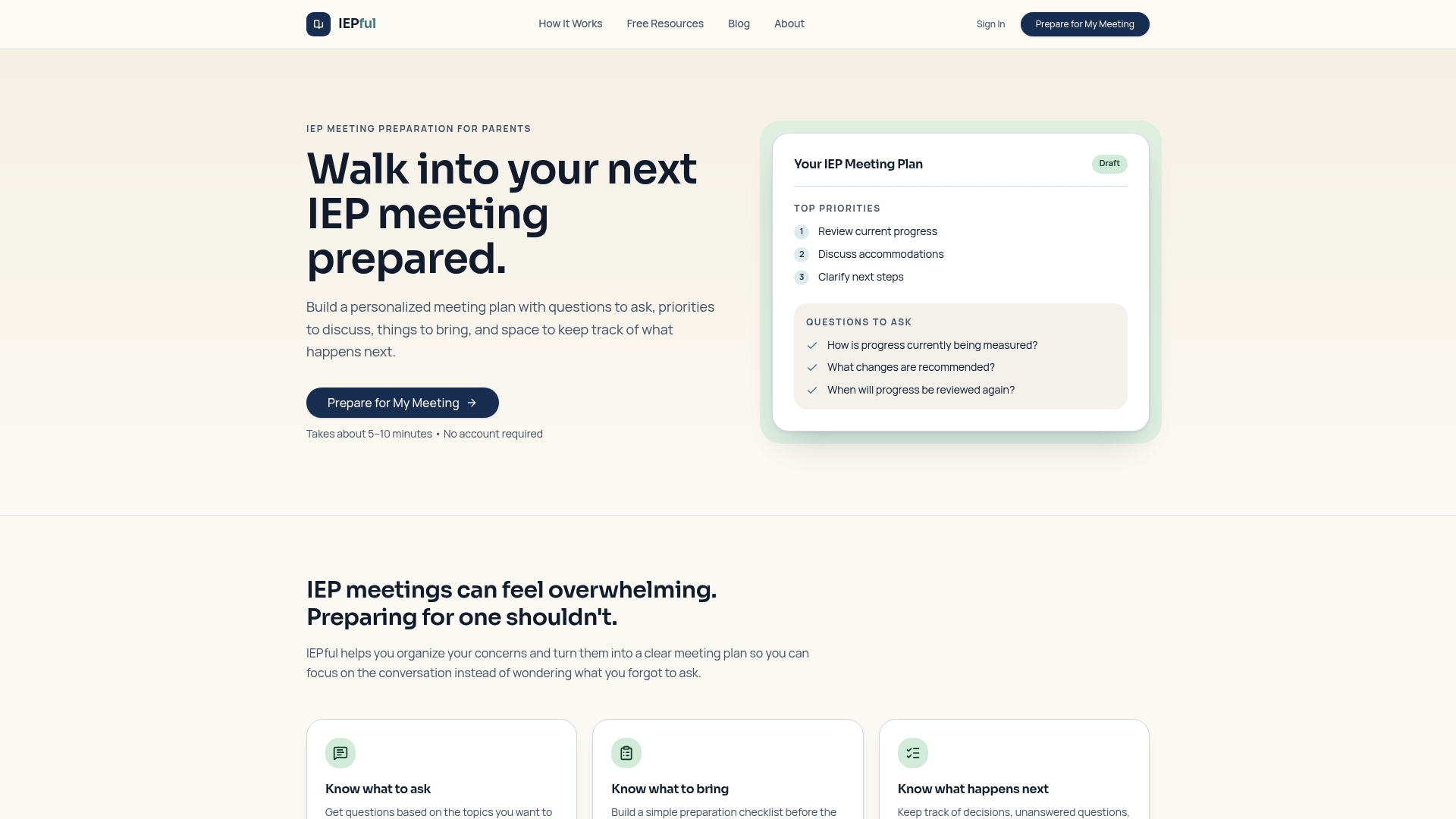
- The free IEP Meeting Plan organizes your priorities and generates a printable, meeting-ready checklist.
- The Complete Meeting Pack adds expanded question sets, printable materials, note-taking templates, and follow-up tracking for $19 one time.
- Parents can build the free plan for the MDR itself, then reuse the same organizing approach for the IEP review meetings that typically follow.
| Feature | Free Plan Builder | Complete Meeting Pack |
|---|---|---|
| Cost | Free | Paid premium option |
| Setup time | About 5 to 10 minutes | Builds on the free plan |
| Account required | No | Optional |
| Includes | Prioritized questions, printable checklist | Additional questions, printables, notes, follow-up tools |
Start with the Plan Builder as soon as you know a meeting date, so you have a working document instead of a blank page the night before.
Sources
The rules covered above come directly from federal special education regulations and guidance, along with practical materials from parent-advocacy organizations.
- 34 CFR §300.530 — Manifestation determination
- U.S. Dept. of Education — Discipline Q&A (OSEP guidance)
This article is general information, not a substitute for advice from a qualified lawyer. Consult a qualified legal professional about your own circumstances before acting on anything here.
FAQ
Does a 504 plan require a manifestation determination meeting?
Students with protections under Section 504 of the Rehabilitation Act who face a disciplinary change of placement are entitled to a review of whether the behavior relates to the disability, though the specific procedures can differ from IDEA’s IEP-based process. Districts often use a comparable meeting structure, but families should confirm the exact procedure with their school’s Section 504 coordinator.
What are the requirements for a manifestation determination in Florida?
Florida school districts follow the federal framework set out in 34 CFR §300.530, including the 10-school-day timeline and the two-part legal test, while implementing it through their own district-level discipline procedures. Parents should check their specific district’s IEP procedural handbook for any added local steps, since federal law sets the floor rather than the ceiling.
What are the 13 disability categories that qualify for an IEP?
IDEA recognizes specific disability categories, including autism, deaf-blindness, deafness, emotional disturbance, hearing impairment, intellectual disability, multiple disabilities, orthopedic impairment, other health impairment, specific learning disability, speech or language impairment, traumatic brain injury, and visual impairment. Eligibility depends on both the category and a demonstrated need for special education services, not the label alone.
What happens if parents appeal the manifestation determination?
Parents can request an expedited due process hearing, which must be arranged within 20 school days of the complaint and decided within 10 school days after the hearing. During that period, the child generally stays in the interim placement they were already in, particularly in special-circumstances cases involving weapons, drugs, or serious bodily injury.
Made with BabyLoveGrowth’s AI tools
IEPful provides educational planning and organization information, not legal, medical, or individualized professional advice. Requirements and procedures can vary; verify current information with official sources.