3 Questions to Decide IEP vs 504 for U.S. Parents

An IEP provides specially designed instruction and measurable goals under IDEA because the child needs specialized teaching to make progress. A 504 plan provides accommodations under Section 504, a civil-rights law, to remove barriers so a child can access the same curriculum as everyone else. Neither is automatically “better.” The comparison chart below breaks down the practical differences so you can match the plan to what your child actually needs.
TL;DR:
- A 504 plan covers a wider range of students with impairments that limit major life activities, requiring accommodations rather than specialized instruction.
- An IEP is necessary when a child’s disability falls into specific categories and needs targeted, measurable goals with related services and progress tracking.
- Eligibility for an IEP depends on meeting one of 13 IDEA disability categories and demonstrating the need for specialized teaching, while 504 requires a substantial life activity limitation regardless of diagnosis.
- Schools require full reevaluations every three years for IEPs, whereas 504 plans are reviewed less strictly, often annually, with informal progress notes possible.
- Dispute resolution processes differ, with IDEA providing more procedural safeguards like mediation and hearings, while 504 disputes typically involve district coordinators and OCR.
Table of Contents
- IEP vs 504 Plan: A Side-by-Side Comparison
- Who Qualifies: IDEA’s 13 Categories vs Section 504’s Broader Standard
- Who Builds the Plan and How Evaluation Works
- How Progress Gets Tracked (or Doesn’t)
- How to Decide: IEP or 504?
- What Are Your Rights if You Disagree With the School?
- What Happens After High School?
- A Parent’s Honest Take on Meeting Anxiety
- Prepare for Your Next Meeting With IEPful
- Where to Verify Your Rights
- Sources
- FAQ
IEP vs 504 Plan: A Side-by-Side Comparison
The two plans come from different laws, and that single fact drives almost every practical difference between them. IDEA is a special education law. Section 504 is a civil-rights law. That distinction shapes who qualifies, what the school has to provide, and how disputes get resolved.
| Dimension | IEP (IDEA) | 504 Plan (Section 504) |
|---|---|---|
| Law that covers it | Individuals with Disabilities Education Act | Section 504 of the Rehabilitation Act |
| Who qualifies | One of 13 disability categories AND a demonstrated need for specialized instruction | Any physical or mental impairment that substantially limits a major life activity |
| What’s included | Specially designed instruction, related services, measurable annual goals | Accommodations and modifications to remove access barriers |
| Progress tracking | Required measurable goals with formal progress reports | Typically no formal goals; some plans include informal check ins |
| Team and consent | Required team (parent, teacher, special ed staff, district rep); written parental consent needed for evaluation and services | Team composition varies by district; consent practices differ locally |
| Review schedule | Annual review; full reevaluation at least every three years | Reviewed periodically, often annually, but timing varies by district |
| Dispute resolution | Mediation, due process hearing, formal procedural safeguards | Complaint to the district’s 504 coordinator or the Office for Civil Rights |
A child with ADHD might qualify for either, depending on whether the condition also requires specialized instruction or only needs accommodations like extended time and organizational support. A child managing diabetes usually needs a 504 plan to cover glucose monitoring, medication timing, and bathroom access rather than academic instruction.
Who Qualifies: IDEA’s 13 Categories vs Section 504’s Broader Standard
IDEA eligibility runs on two tests, not one. A child must fall into one of 13 recognized disability categories, things like specific learning disability, autism, speech or language impairment, or other health impairment, and the team must find that the disability requires specialized instruction to make progress. Meeting the category alone isn’t enough.
Section 504 casts a wider net. A student qualifies with any physical or mental impairment that substantially limits a major life activity, which includes learning, concentrating, reading, or even major bodily functions. That’s why kids with well-managed ADHD, food allergies, or anxiety often land on a 504 rather than an IEP: they need barriers removed, not specialized teaching.
What each plan typically contains:
- IEP: present levels of performance, measurable annual goals, specific services (speech therapy, resource room time), and a service delivery schedule.
- 504: accommodations like extended test time, preferential seating, a health plan, or reduced homework load.
- IEP: related services such as occupational therapy or counseling written into the document with minutes per week.
- 504: modifications like access to an elevator, a 504 health care plan for insulin administration, or breaks during testing.
Who Builds the Plan and How Evaluation Works
The IEP team has a fixed roster: the parent, at least one general education teacher, a special education teacher, someone who can interpret evaluation results, and often a district representative. Schools need written parental consent before evaluating a child and again before starting services, and IDEA also has stronger procedural safeguards, including timelines the district has to follow.
Section 504 team composition is more flexible, and documentation practices vary widely by district. Some districts use the same evaluation data for both 504 and IDEA referrals; others run separate processes entirely, so it’s worth asking for the written policy at your school.
- IEPs get a full reevaluation at least every three years, with annual reviews in between.
- 504 plans are typically reviewed on a less rigid schedule, often annually, but you can request a review sooner if things aren’t working.
- If progress stalls under either plan, put your reevaluation request in writing and reference specific examples of the gap.
How Progress Gets Tracked (or Doesn’t)
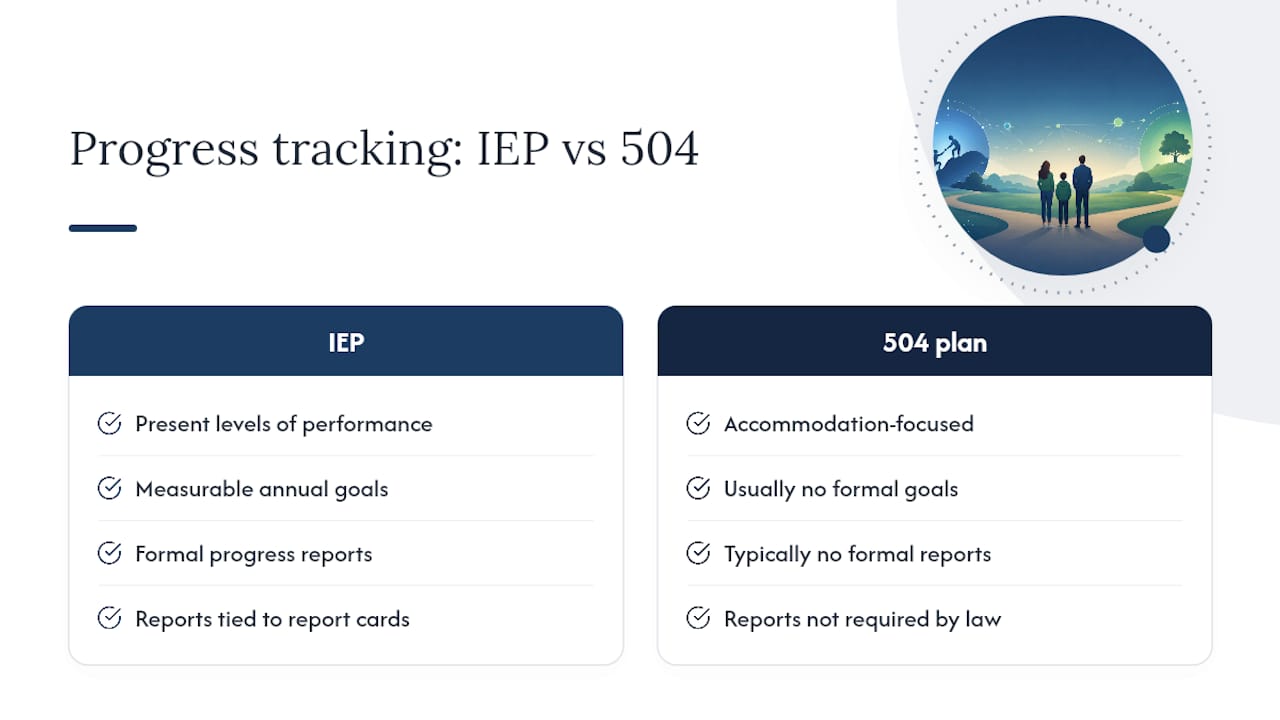
This is where the two plans diverge sharply. An IEP requires present levels of performance, measurable annual goals, and formal progress reports, usually tied to report card periods, so you know in concrete terms whether your child is closing a gap. A 504 plan is accommodation focused. It usually skips formal goals altogether because the point isn’t to teach a new skill, it’s to remove a barrier that already exists.
That doesn’t mean you’re stuck without data. You can ask the 504 coordinator for informal progress notes or teacher check ins on a set schedule, and many schools will agree to it even though nothing in Section 504 requires it.
How to Decide: IEP or 504?
Run your child’s situation through three questions before you request either plan.
- Is the disability affecting access or affecting learning? If accommodations alone (extra time, seating, a health plan) would let your child perform at grade level, a 504 may be enough. If the child needs someone to actually teach differently, that points toward an IEP.
- Have accommodations already been tried? If your child has had a 504 for a year and grades or skills still aren’t moving, that’s a signal to request a full IDEA evaluation.
- Does the child need specialized instruction or curriculum modification? Extended time is an accommodation. A modified curriculum or specially designed reading instruction is special education, and that’s an IEP conversation.
Bring these questions to your next meeting:
- How will progress be measured, and how often will I get updates?
- Who delivers each service, and how many minutes per week?
- What happens if my child doesn’t meet a goal by the next review?
- What’s the process if I disagree with the team’s recommendation?
Before the meeting: request an evaluation in writing, gather report cards, work samples, and any outside evaluations, and schedule the meeting with enough lead time for the school to prepare.
Pro Tip: Keep a simple email thread with the school for every request and follow-up. When a meeting drags on or a dispute comes up months later, dated written records carry more weight than your memory of a phone call.
What Are Your Rights if You Disagree With the School?
IDEA comes with formal procedural safeguards: you can request mediation, file a state complaint, or request a due process hearing if you and the school can’t agree on eligibility, services, or placement. Section 504 disputes route differently, usually through the district’s 504 coordinator first, and then to the Office for Civil Rights if the district doesn’t resolve it. Education Week’s analysis notes that IEP protections tend to be more procedurally robust than 504 enforcement mechanisms, which is one reason advocates push for an IDEA evaluation when a child’s needs are significant.
- Document every meeting, request, and denial in writing.
- Ask for a copy of your procedural safeguards notice at every IEP meeting.
- If a 504 complaint stalls at the district level, OCR accepts complaints directly from parents.
What Happens After High School?
IEP services and the transition planning requirement under IDEA generally end when a student graduates or ages out, typically at 21 or 22 depending on the state, and the IEP team must build a transition plan addressing life after high school starting well before that point. Section 504 protections don’t disappear. They follow the student into any college or workplace that receives federal funding, though the process shifts: the student, not the school, now has to request accommodations and provide documentation. Start collecting evaluation reports and accommodation histories in high school. Colleges will ask for recent documentation, and an outdated one can slow down approval.
A Parent’s Honest Take on Meeting Anxiety
Most parents walk into their first IEP or 504 meeting with more dread than the paperwork deserves, and that’s normal, not a sign you’re unprepared. The single most useful thing you can bring isn’t a binder of research. It’s a one-page list of your top three priorities and the exact questions you want answered before you leave the room.
— Sam
Prepare for Your Next Meeting With IEPful
Reading the differences between an IEP and a 504 is one thing. Walking into a meeting room and advocating clearly for your specific child is another, and that’s the part most parents actually struggle with. IEPful turns your child’s situation into a personalized meeting plan in about 5 to 10 minutes, no account required to get started.
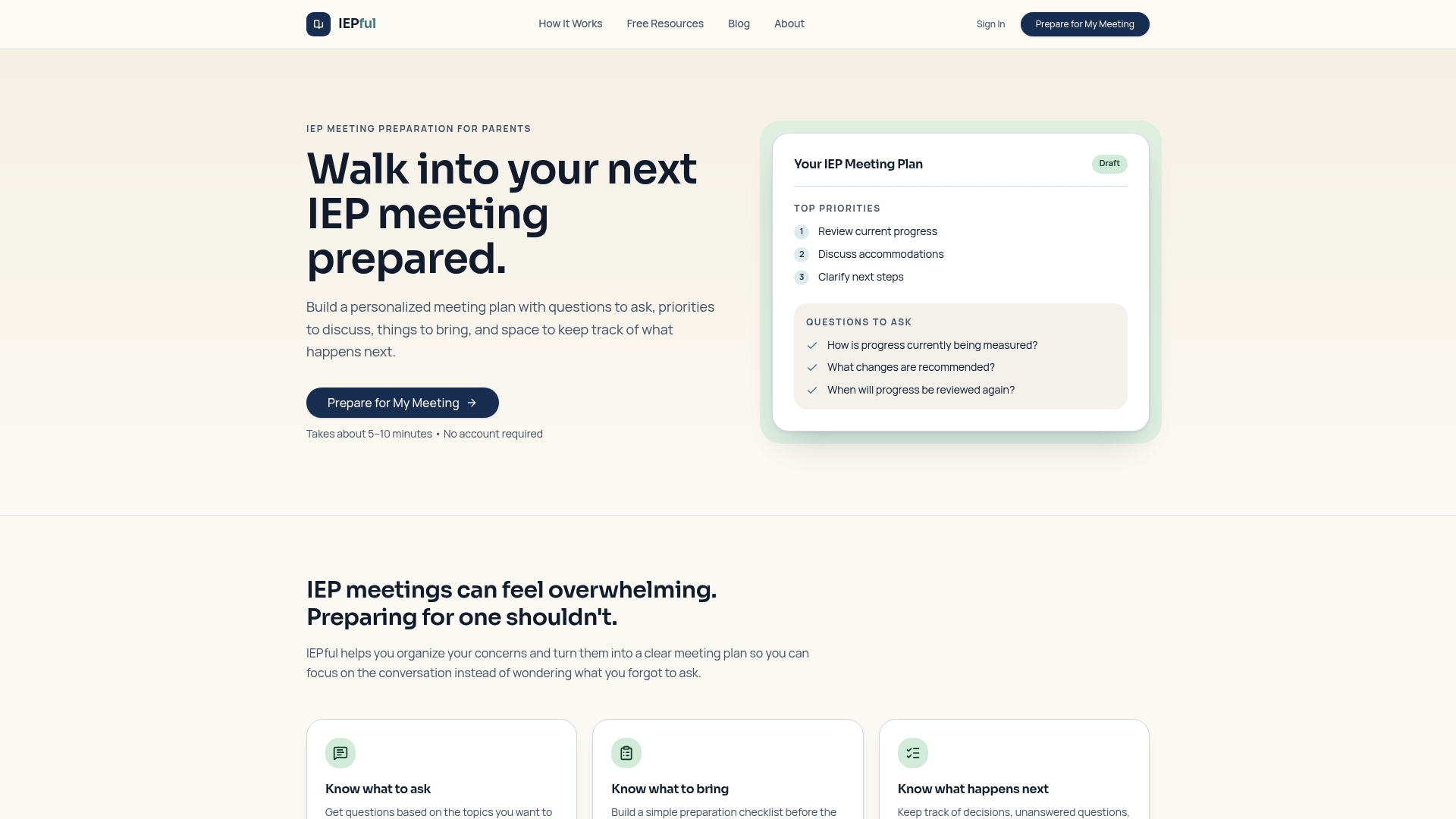
The free meeting plan builder walks you through setting priorities, generating the right questions for your child’s exact circumstances, and building a checklist you can bring straight into the meeting. For parents who want more, the Complete Meeting Pack adds a printable meeting pack along with note taking and follow-up tracking so nothing said in the room gets lost afterward. It fits parents heading into a first eligibility meeting just as well as those managing an annual IEP review or a tense 504 dispute. Start your personalized meeting plan before your next meeting lands on the calendar.
Where to Verify Your Rights
- IDEA regulations on IEP team and content
- IEPs vs. 504 plans — CHOP
- The difference between IEPs and 504 plans — Understood
For questions specific to your district, contact your school’s special education office or a local advocate before relying on general guidance.
Sources
- IEPs vs. 504 plans: Understanding the difference — Children’s Hospital of Philadelphia (CHOP)
- The difference between IEPs and 504 plans — Understood
FAQ
Why do schools push a 504 plan instead of an IEP?
Schools sometimes favor a 504 because the eligibility bar is lower and it requires less paperwork and fewer procedural obligations than an IEP. That’s not necessarily wrong for every child, but if accommodations alone haven’t fixed the problem, you can request a full IDEA evaluation in writing at any time.
Is a 504 more serious than an IEP, or is it the reverse?
Neither plan is inherently “more serious.” An IEP generally addresses more significant needs because it provides specialized instruction, while a 504 addresses access barriers for a broader range of conditions. The right plan depends on whether your child needs different teaching or just a barrier removed.
Is an IEP or 504 harder to get?
An IEP has a stricter two-part test: the child must fall into one of the 13 IDEA disability categories and need specialized instruction. A 504 only requires a substantial limitation on a major life activity, which is why more students qualify for 504 plans than IEPs.
Is a 504 or IEP better for ADHD?
It depends on severity and impact. A child with ADHD who needs extended time, seating changes, or organizational support often does well with a 504 plan, while a child whose ADHD significantly disrupts learning and requires specialized instruction may need a full IEP. Tools like meeting plan builders can help you organize the specific examples that show which level of support your child actually needs.