2–4 Enforceable IEP Accommodation Statements for U.S. Parents

Accommodations change how a student accesses learning, not what they’re expected to learn, and they fall into six practical categories: classroom setup, curriculum supports, testing, assistive technology, behavioral or health needs, and writing. The strongest accommodations name the setting, frequency, duration, and the staff member responsible, echoing what IDEA regulations require the IEP to state. Walk into the meeting with two to four prioritized, specific requests rather than a long wish list.
TL;DR:
- Classroom accommodations should specify exact locations, such as seating within 10 feet of the teacher and away from doors, to ensure consistent implementation.
- Curriculum supports must clarify whether they involve changing delivery methods or reducing content, with clear wording to prevent confusion with modifications.
- Testing accommodations need precise details on timing, setting, and response adjustments, and must align with state assessment rules to avoid unsupported supports.
- Assistive technology requires comprehensive planning, including training and trial periods, with clear documentation of usage, responsible staff, and progress measures.
- Behavior, health, and sensory supports should be explicitly documented for all school settings, including lunch and field trips, with specific access provisions like quiet spaces or sensory tools.
Table of Contents
- Classroom and Learning-Environment Accommodations
- Curriculum and Instructional Supports
- Testing and Assessment Accommodations
- Assistive Technology and Accessible Materials
- Behavioral, Health, and Sensory Accommodations
- Writing and Handwriting Accommodations
- Writing Operational Accommodation Statements
- Quick Meeting-Prep Checklist
- Build a Personalized Meeting Plan With IEPful
- Sources
- FAQ
Classroom and Learning-Environment Accommodations
A classroom accommodation removes a physical or sensory barrier without touching the curriculum itself. These are usually the easiest wins at an IEP meeting because teachers can implement most of them without new training or equipment.
- Preferential seating. A seat near the teacher, away from doors or windows, cuts down distractions for kids with attention or sensory challenges.
- Chunked, repeated directions. Multi-step instructions get broken into smaller pieces, delivered orally, with the student restating the task back to confirm understanding.
- Visual dividers or study carrels. Reduced visual clutter helps students who lose focus in an open classroom layout.
- Cueing systems. A quiet signal (a tap, a card on the desk) redirects attention without calling out the student in front of peers.
- Scheduled or on-demand breaks. A break pass or a set number of movement breaks per hour supports kids who need to reset.
Wake Forest’s disability resources office lists exactly these kinds of supports, including oral or repeated directions and chunked assignments, as standard classroom accommodations.
Pro Tip: Don’t just ask for “preferential seating.” Write it as “seated within 10 feet of the teacher’s primary instruction area, away from the classroom door, in all core subject classes.” Vague seating requests get implemented inconsistently once the school year gets busy.

Curriculum and Instructional Supports
Curriculum accommodations change the delivery or format of instruction while keeping the same learning standard. This is the category parents most often confuse with modifications, so it’s worth pausing on the difference.
An accommodation changes how a student accesses the same grade-level material: a shortened assignment that still covers all required concepts, a graphic organizer for essay planning, or a model example attached to every new assignment type. A modification changes what the student is expected to learn: fewer required concepts, a lower reading level text, or grading against a different standard. Both belong in an IEP when appropriate, but mixing them up in your request can lead to a support that doesn’t actually address the goal.
Common curriculum-level supports include:
- Reduced number of problems per assignment, covering the same skills
- Prioritized homework, with the most essential items marked first
- Study guides provided at least three days before a test
- Graphic organizers for writing and reading comprehension tasks
- Modeled examples attached to new assignment formats
Sample wording: “Student will complete every other problem on math worksheets, covering all assigned standards, in all general education math classes.”
Testing and Assessment Accommodations
Testing accommodations fall into four categories: presentation, response, setting, and timing. Presentation changes how the test is delivered (large print, audio, Braille). Response changes how the student answers (scribe, speech-to-text, marking answers in the test booklet instead of a separate sheet). Setting changes where the test happens (small group, separate room, reduced distractions). Timing changes how long the student gets or how the test is scheduled (extended time, extra breaks, testing across multiple sessions).
Common testing accommodation examples:
- Extended time (such as 1.5 times standard time, though the IEP should state the exact ratio)
- Small-group or separate testing setting
- Large print or Braille materials
- Read-aloud accommodations, when the specific test format allows it
- A scribe for written responses
- Scheduled breaks during testing
- Permission to use medication, glucose monitors, or other medical equipment during testing
According to ADA guidance on testing accommodations, the goal is removing access barriers without changing what the test measures. Some state assessments restrict specific supports, such as read-aloud on a reading-comprehension section, so confirm the exact rules with your state’s testing manual and request assessment-specific wording in the IEP rather than assuming classroom accommodations automatically apply to state tests.
Sample IEP wording: “Student will receive extended time and testing in a small-group setting for all district and state assessments, as permitted by the assessment’s accommodation guidelines.”
Assistive Technology and Accessible Materials
Assistive technology (AT) only works if the IEP documents more than the device name. PACER’s guide to assistive technology notes that when AT is included in an IEP, the team should record where it is used, how it will be trialed, and who trains the student and staff on it. Schools must provide the AT at no cost to the family once it’s written into the IEP.
Common AT examples:
- Text-to-speech software for reading assignments and tests
- Speech-to-text for writing tasks
- Word prediction software to support spelling and writing fluency
- Adapted keyboards or alternative input devices
- Augmentative and alternative communication (AAC) devices
- Audio versions of textbooks and reading materials
A device sitting unused in a drawer helps nobody. Successful AT often depends more on training and a real trial period than on the tool itself, which is why the implementation plan matters as much as the equipment.
Pro Tip: Ask specifically who trains your child on new software or devices, and by what date. “The student will use text-to-speech” is not the same as “the special education teacher will train the student on Read&Write by [date], with a 30-day trial and check-in.”
Sample wording: “Student will use speech-to-text software for written assignments over three sentences in all classes, with initial training provided by the assistive technology specialist within two weeks of IEP implementation.”
Behavioral, Health, and Sensory Accommodations
These supports address needs that show up outside of purely academic tasks, and they matter as much at lunch and recess as they do in the classroom. Supplementary aids and services, including adapted equipment, peer support, and staff training, should be considered across the whole school day, not just core instruction.
- Scheduled check-ins with a counselor or case manager
- Visual or verbal cueing systems for behavior redirection
- Sensory toolkits (fidgets, noise-canceling headphones, weighted lap pads)
- Access to snacks or medication on a set schedule
- A designated quiet space for de-escalation
IDEA regulations require the IEP team to consider supplementary aids across nonacademic settings like field trips, assemblies, and lunch, so ask explicitly whether a requested support follows your child there too.
Sample wording: “Student will have access to a designated quiet space during lunch and recess, available upon request to any classroom or lunchroom staff member.”
Writing and Handwriting Accommodations
Kids who know the material can still get stuck if handwriting or transcription is the bottleneck. Common supports include typed responses instead of handwritten ones, speech-to-text for longer assignments, a scribe for tests, reduced copying from the board, and access to teacher notes or outlines instead of copying lecture content by hand.
Specify exactly when each applies. “Typed responses allowed” is too broad; “typed responses allowed for all assignments over one paragraph, in all classes, including tests” tells staff precisely what to implement and when.
Sample wording: “Student may submit typed responses for all writing assignments exceeding three sentences and will receive copies of teacher notes for units involving board-based instruction.”
Writing Operational Accommodation Statements
IDEA requires the IEP to state the frequency, location, duration, and start date of services and accommodations, and to specify individual testing accommodations separately for state and district assessments. Vague phrasing like “may have extra time if needed” doesn’t meet that bar, and PACER’s own guidance on accommodation wording specifically warns against conditional language like “if necessary.”
Turn any request into an operational statement using this sequence:
- Name the barrier (“difficulty completing timed math tests”)
- State the accommodation (“extended time, 1.5x standard”)
- Name the setting (“all math tests, in-class and district assessments”)
- State frequency and duration (“every test, for the current IEP year”)
- Name who is responsible (“general education math teacher, with support from the case manager”)
- State how progress will be measured (“test completion rate tracked monthly”)
| Category | Sample operational statement |
|---|---|
| Classroom | Seated within 10 feet of the teacher in all core classes, effective immediately |
| Assistive technology | Speech-to-text training provided by the AT specialist within two weeks, 30-day trial, progress reviewed at trial’s end |
| Assessment | 1.5x extended time and small-group setting for all state and district assessments, as permitted by assessment guidelines |
At the meeting, ask directly: Who implements this day to day? How will progress be measured, and how often? Is there a trial period? Where will this be documented so a substitute or new teacher can follow it?
Quick Meeting-Prep Checklist
Walking in prepared changes the tone of the whole meeting. Here’s a short sequence that works.
- Gather documents. Bring the current IEP, recent work samples, teacher notes, and any evaluation summaries.
- Prioritize your requests. Pick two to four accommodations that address the biggest barriers, not everything you’ve ever considered.
- Propose with specifics. State the barrier, then offer the operational wording (setting, frequency, responsible staff) rather than a general idea.
- Ask for assessment-specific language. If a classroom accommodation needs to extend to state or district tests, say so explicitly.
- Request a trial and a measure. Ask how success will be tracked and when the team will revisit the accommodation.
- After the meeting, request the final wording in writing, get written notes on what was agreed, and confirm a review date.
Pro Tip: Write your two to four priority accommodations on a single page before the meeting. Handing the team a short, clear list is far more effective than talking through a mental checklist under time pressure.
Build a Personalized Meeting Plan With IEPful
Turning a list of accommodation examples into wording that actually gets adopted at your child’s meeting is the hard part, and that’s exactly the gap a free Plan Builder tool is built to close. In about five to ten minutes, with no account required, it helps you organize your priorities, generates specific questions for the team, and produces a personalized checklist you can bring to the meeting.
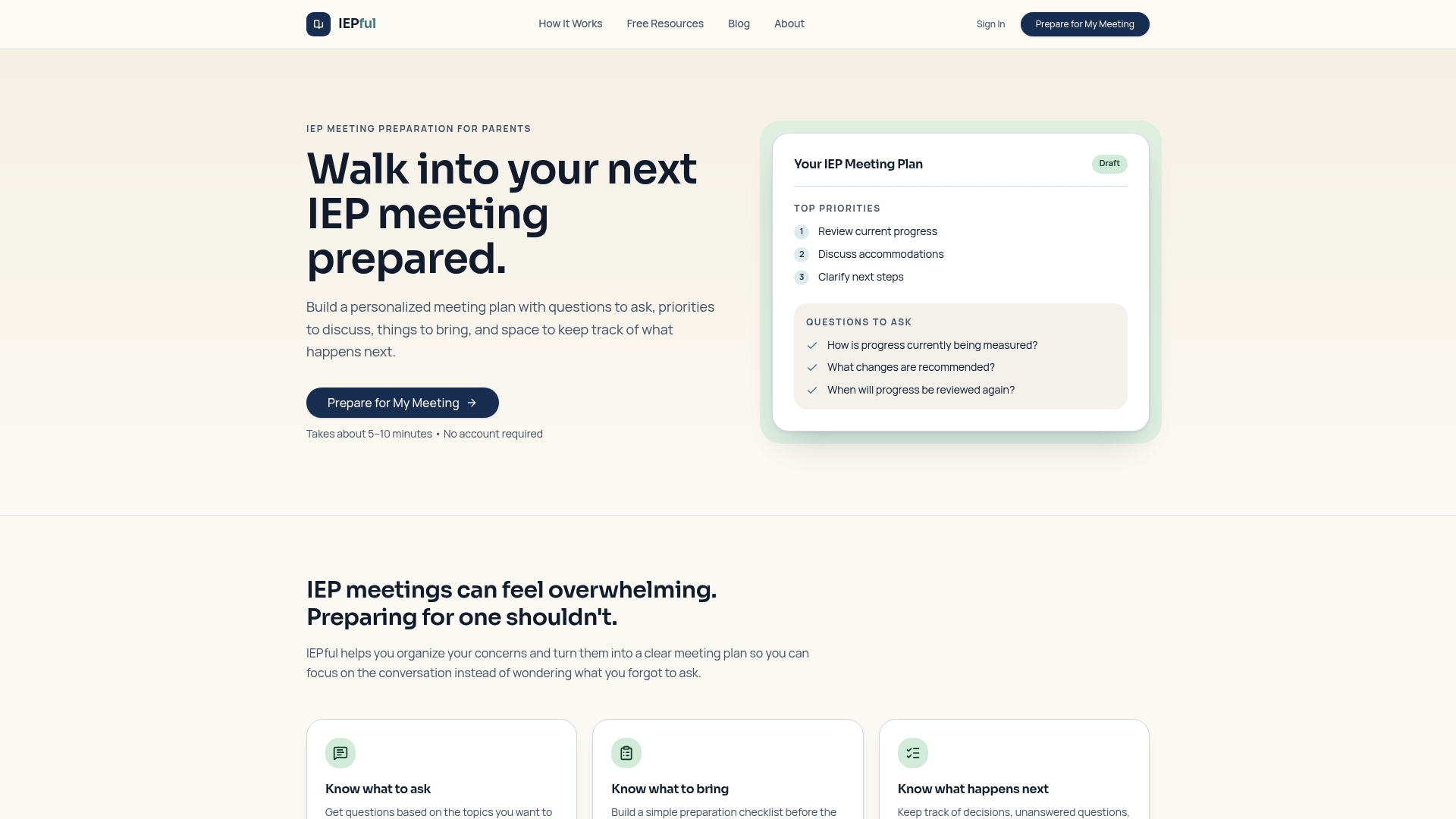
If you want more, the optional one-time Complete Meeting Pack ($19) adds expanded question sets, printable preparation materials, note-taking tools, and follow-up tracking for after the meeting. Most families can get real value from the free version alone. Build your free IEP meeting plan now and walk into your next meeting with the specific accommodations covered in this article already organized and ready to propose.
Sources
- IDEA regulations: Individualized Education Program (IEP) content (34 CFR §300.320)
- PACER guide to assistive technology
- ADA guidance on testing accommodations
- Supplementary aids and services examples (Center for Parent Information and Resources compilation)
- Examples of accommodations for classroom instruction (Wake Forest faculty disability resources)
FAQ
What are the most common IEP accommodations?
The most common accommodations include preferential seating, extended time on tests, chunked directions, breaks, and assistive technology like text-to-speech. Classroom accommodation lists also frequently include highlighted key information and audio versions of text.
What are the 13 disability categories that qualify for an IEP?
IDEA lists disability categories including specific learning disability, autism, other health impairment (often used for ADHD), speech or language impairment, emotional disturbance, and intellectual disability, among others. A child must meet a category’s criteria and be found to need special education services to qualify for an IEP.
What are examples of reasonable school accommodations?
Three common examples are extended time on tests, a distraction-reduced testing setting, and speech-to-text software for writing assignments. Each addresses a specific barrier without changing what the student is expected to learn or how a test measures skill.
What’s the difference between an accommodation and a modification?
An accommodation changes how a student accesses the same grade-level content, like a shortened assignment covering identical standards. A modification changes what’s expected, such as reducing the number of required standards or grading against a different benchmark.
How specific does accommodation wording need to be in an IEP?
IDEA requires accommodations to state frequency, location, and duration, so wording like “may have breaks if needed” doesn’t meet that standard. A personalized meeting plan can help you draft specific, operational requests before you walk into the meeting.
Recommended
Written with BabyLoveGrowth tools
IEPful provides educational planning and organization information, not legal, medical, or individualized professional advice. Requirements and procedures can vary; verify current information with official sources.