15–20 Minute IEP Draft Review: Sample Questions for U.S. Parents

If you have a draft IEP in hand, spend your time on three things: request any missing records in writing today, check whether the present levels and goals are backed by real data and numbers, and write down three to five questions tied to anything vague. If you don’t have a draft yet, ask for one now. Federal law gives you the right to see it before the meeting happens.
TL;DR:
- Review the student’s baseline data in the present levels to ensure it accurately reflects current performance and matches observations from home.
- Confirm that all annual goals are measurable, including clear baselines, targets, and intervals for tracking progress, rather than vague descriptions.
- Ensure services and accommodations specify frequency, duration, provider, and setting, avoiding vague phrases such as “as needed.”
- Request and review all relevant evaluation reports and draft IEP documents at least 45 days before the meeting, keeping records of communication.
- Prepare a prioritized list of specific questions about unclear goals, missing services, or vague progress reporting to guide productive discussion during the meeting.
Table of Contents
- How Do You Review an IEP Draft Before a Meeting?
- Reviewing Each Section: What to Check and What to Ask
- How to Request Records and Timelines Before the Meeting
- Turning Your Review Into a Meeting Agenda
- Red Flags in a Draft IEP and What to Do Next
- Using IEPful’s Plan Builder to Organize Your Review
- Where to Verify These Rules Yourself
- Get Organized Before Your Next IEP Meeting
- Sources
- FAQ
How Do You Review an IEP Draft Before a Meeting?
Reviewing a draft IEP well starts with a fast scan, not a deep read. Before you dig into every paragraph, run through this checklist to catch anything obviously missing or wrong. Print it, or keep it open on your phone during your first pass.
First pass: confirm you have what you need.
- The full draft IEP, plus any recent evaluation reports or reevaluation summaries.
- The date you received these documents (write it down, even mentally).
- Student identification info, meeting date, time, and location, all correct.
- A summary of proposed services, even a rough one, so you know what’s being offered.
Second pass: scan for the five load-bearing sections.
- Present levels of academic achievement and functional performance (PLAAFP).
- Annual goals and how progress toward them will be measured.
- Services, accommodations, and related services, including minutes and setting.
- Placement and least restrictive environment (LRE) language.
- Progress reporting: how often, and in what format.
Third pass: logistics for the meeting itself.
- Decide who from your side will attend. A spouse, grandparent, or advocate is allowed.
- If you need an interpreter, request one now. Districts are required to provide one for parent participation under 34 C.F.R. §300.322.
- If any document referenced in the draft is missing (a speech evaluation, a behavior plan), request a copy before the meeting.
This scan takes fifteen to twenty minutes and tells you where to focus your deeper read. Most drafts have at least one weak section. Finding it now, instead of during the meeting, is what turns you from a passive attendee into an active team member.
Reviewing Each Section: What to Check and What to Ask
A draft IEP is really five documents stitched together, and each one has its own failure points. Here’s how to work through them one at a time, with the specific language to look for and the questions to bring if something’s missing.
Present levels (PLAAFP): does it match the kid you know?
The present levels section should read like a snapshot of your child right now, backed by data: test scores, work samples, teacher observations, and specific examples. If it reads like a template with your child’s name-dropped in, that’s a problem worth raising.
Look for baseline statements (“reads 45 words per minute with 80 percent accuracy” rather than “struggles with reading”). Check that the description matches what you see at home. If the draft says your child “participates well in group work” and you know that’s a struggle, that mismatch belongs on your question list.

Pro Tip: Bring one or two concrete examples from home, a recent report card comment, a text from a teacher, a worksheet with your child’s actual work. Specific evidence moves a conversation faster than a general disagreement ever will.
Annual goals: are they actually measurable?
Federal regulations require IEPs to include measurable annual goals along with a clear description of how and when progress will be measured, under 34 C.F.R. §300.320. That’s the legal floor. A goal that lacks a baseline, a target, and a timeframe fails that standard, even if it sounds reasonable on paper.
Here’s the difference in practice:
- Vague: “Student will improve reading comprehension.”
- Measurable: “Given a grade-level passage, student will answer comprehension questions with 80 percent accuracy in 4 out of 5 trials, measured monthly, by the next annual review.”
Effective goals need a clear baseline, an observable and countable criterion, and a defined interval for checking progress, according to Emporia Online’s guide to writing IEP goals. If a goal in the draft is missing any of those three pieces, ask directly: “What’s the baseline this goal is measured from, and how often will we see data on it?”
Services and accommodations: who, how much, and where?
This is where drafts get vague on purpose or by accident, and it’s the section most likely to cause disputes later. Every service listed should specify:
- Type (speech therapy, resource room support, occupational therapy)
- Frequency (twice weekly, daily)
- Duration (30 minutes per session)
- Provider (a specific role, like “certified speech pathologist”)
- Setting (general education classroom, pull-out room, resource setting)
“As needed” is the phrase to flag every time you see it attached to a service or accommodation. It sounds flexible, but it usually means nobody is accountable for delivering anything on a schedule. If the draft says “extended time as needed” instead of “50 percent extended time on all tests and quizzes,” ask for the specific version in writing.
Related services: don’t let vague minutes slide
Related services like counseling, transportation, or occupational therapy need the same specificity as core services: explicit frequency, provider, start date, and setting. A draft that says “OT services to support fine motor skills” without minutes attached is not a complete plan. It’s a placeholder.
Ask: “How many minutes per week, delivered by whom, starting when, and in what location?” That single question, asked section by section, will surface most of the vagueness in a typical draft.
Placement and least restrictive environment
The placement section should say plainly how much time your child spends in general education versus pulled out, and why. Look for actual percentages or minutes, not just a label like “resource room.” If your child is transitioning between settings (elementary to middle school, or a change in placement type), the draft should include specific transition steps and a timeline, not just a mention that a transition will happen.
Progress reporting: how will you actually know?
IDEA requires the IEP to state when periodic progress reports will be provided, tied to the goals described earlier in the content requirements at §300.320. Check the draft for three things: how often reports come (quarterly is standard in many districts, but confirm it), what format they arrive in (a checkbox rating, a narrative, raw data), and who sends them.
A significant portion of school-age children qualify for special education services under IDEA, meaning many IEP teams handle numerous reviews each reporting period. A generic progress note is often a symptom of volume, not neglect. However, it’s still worth pushing for specifics.
If the draft says progress will be reported “as part of report cards,” ask whether that means a letter grade alone or actual goal-by-goal data. Those are very different things.
How to Request Records and Timelines Before the Meeting
If you don’t already have the draft IEP or recent evaluation reports, request them in writing today. Federal regulations guarantee you the right to inspect and review your child’s education records without unnecessary delay, and the district must comply within 45 days of your request at the outside, under 34 C.F.R. §300.613.
Whether you get the draft several days before the meeting or only at the table itself often comes down to state or district practice rather than federal mandate. An OSEP guidance letter confirms this is generally left to state and local officials to decide, though some states set earlier disclosure requirements. Check your state’s rules, but don’t wait to find out. Ask early regardless.
A simple written request works. Something like: “I am requesting a copy of my child’s draft IEP and any recent evaluation reports under 34 C.F.R. §300.613, ahead of our meeting on [date].” Send it by email so you have a timestamp, or by certified mail if you’ve had communication delays before.
Pro Tip: Keep every email you send and receive in one folder, along with the date each document arrived. If a district drags its feet, that dated record is what lets you escalate clearly, whether to a special education director or your State Parent Center, instead of arguing about who said what.

If 45 days pass with no response, document every contact attempt and reach out to your state’s Parent Training and Information Center for next steps.
Turning Your Review Into a Meeting Agenda
Once you’ve read through the draft, narrow your findings to three to five priorities. Trying to raise every concern in one meeting usually means the important ones get buried under the small ones.
- Rank your concerns by impact. A missing measurement method on a core reading goal outranks a wording preference on a minor accommodation.
- Write one question per priority, in plain, factual language. “Can you walk me through how progress on this goal will be measured and how often I’ll see data?” works better than a general complaint about vagueness.
- Decide who’s coming with you. A grandparent, family friend, or advocate can take notes while you focus on the conversation.
- Notify the district in advance if you’re bringing an advocate or professional, since some districts appreciate the heads-up and it avoids surprise at the table.
Parent Center Hub recommends building a short “positive student profile,” a page of your child’s strengths, interests, and needs, to bring alongside your questions, so the meeting isn’t only about problems to solve, according to its guide on developing your child’s IEP. You’re an equal member of this team, and preparation is what makes that role real instead of nominal, not a formality you’re squeezing into.
During the meeting, take notes with timestamps (“At 10:15, the team agreed to add 30 minutes of weekly OT”), and ask for any agreed changes to be put in writing before you leave or shortly after.
Red Flags in a Draft IEP and What to Do Next
Some patterns in a draft show up again and again, and they’re worth flagging the moment you spot them:
- Goals with no baseline, no percentage, and no measurement schedule.
- Services listed with no frequency or duration attached.
- “As needed” language on accommodations that should be consistent.
- Present levels that read like a generic template rather than a description of your child.
- Progress reports with no stated frequency or format.
At the meeting, name the issue specifically rather than expressing general disagreement: “I’d like this goal to include a baseline and a measurable target before we finalize it.” That request, on the record, is what gets language changed.
Pro Tip: If the team agrees to a small, specific fix, like correcting a start date or adjusting minutes, ask whether it can be handled as a written amendment without reconvening the full team. Under 34 C.F.R. §300.324, parents and the district can agree to amend an IEP in writing for limited changes, which is often faster than scheduling a new meeting.
If disagreements go deeper than wording, you have options: request a follow-up meeting, put your concerns in writing and ask for a written response, or contact your State Parent Center for guidance on procedural safeguards. A special education attorney or advocate is worth considering when the disagreement involves placement, a denial of services, or a pattern of unmet goals over multiple review periods.
Using IEPful’s Plan Builder to Organize Your Review
Reading a dense draft and turning it into a clear meeting plan are two different skills, and IEPful’s free Plan Builder is built for the second one. You answer a few questions about your child’s draft and priorities, and it generates a printable checklist and question list organized by IEP section, no account required.
Parents who want more structure can add the one time Complete Meeting Pack for $19, which expands the question bank, adds printable note pages, and includes follow-up tracking for after the meeting. Either version turns your scattered notes and highlighted sections into something you can actually carry into the room.
One boundary worth stating plainly: the Plan Builder organizes your preparation and paperwork. It does not replace legal advice, formal IDEA procedures, or a conversation with your district when disputes go beyond wording.
Where to Verify These Rules Yourself
The federal rules cited throughout this guide come directly from the Individuals with Disabilities Education Act regulations and the U.S. Department of Education’s parent guide to the IEP process. The Center for Parent Information and Resources offers deeper reading on meeting preparation. States can add their own timelines and procedures on top of the federal floor, so check with your State Education Agency for anything specific to where you live.
Get Organized Before Your Next IEP Meeting
You’ve just read through five sections’ worth of things to check, questions to script, and records to request, and doing all of that manually with a notepad works, but it eats hours you probably don’t have between now and the meeting. IEPful is built specifically for that gap: instead of a generic checklist or a blank Word document, the free Plan Builder turns your priorities into a printable, organized meeting plan in minutes, no account required.
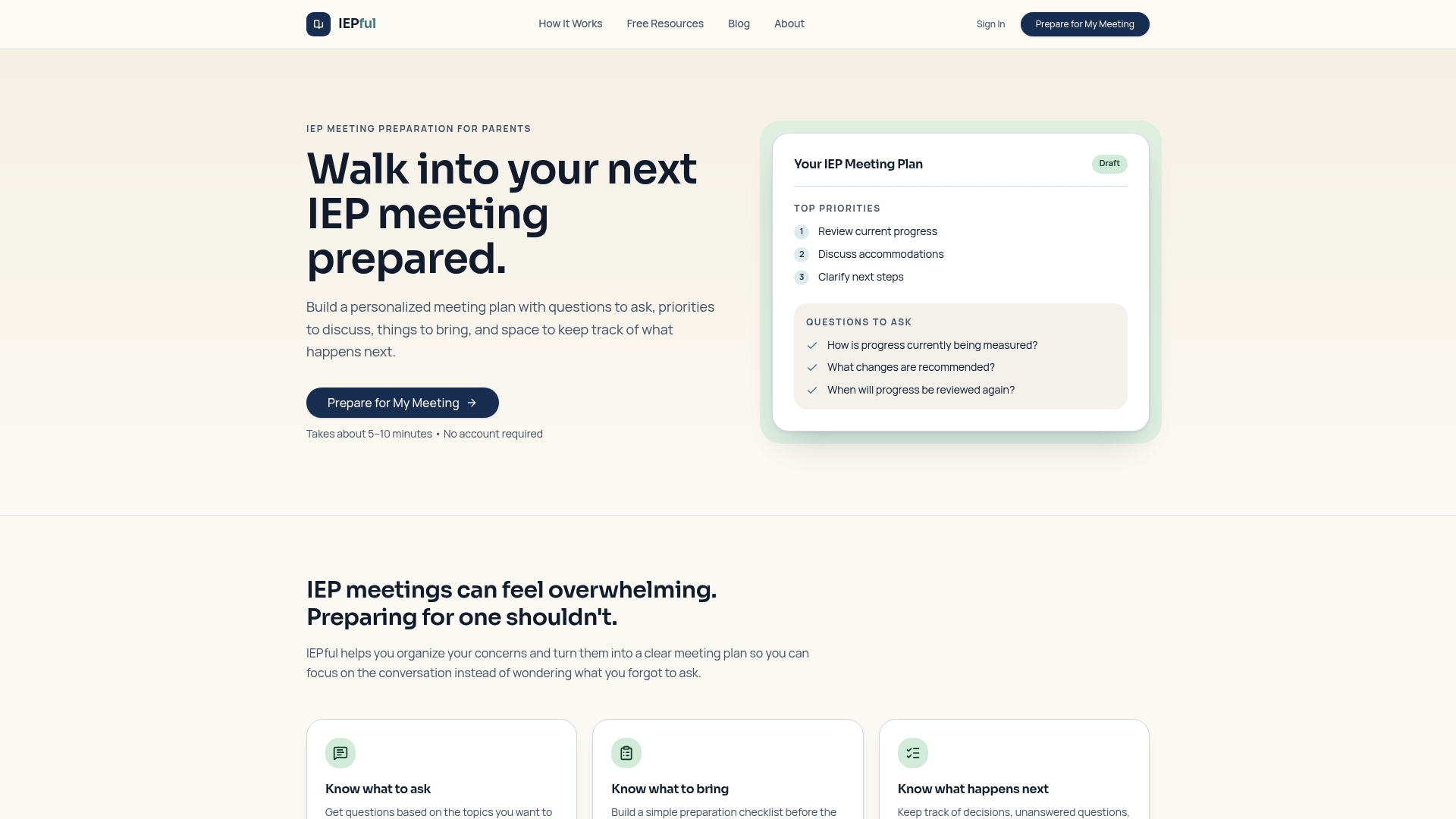
You tell it what’s worrying you about the draft, whether it’s a vague goal, a missing service minute, or unclear progress reporting, and it generates section-specific questions you can bring straight to the table. If you want more than the free version covers, the one time Complete Meeting Pack adds expanded question sets, printable note pages, and a way to track what the team agreed to after the meeting ends. Start with the free IEP meeting plan and have your prioritized agenda ready before your next meeting date.
This article is general information, not a substitute for advice from a qualified lawyer. Consult a qualified legal professional about your own circumstances before acting on anything here.
Sources
- 34 C.F.R. §300.322 Parent participation — Individuals with Disabilities Education Act
- Developing Your Child’s IEP — Center for Parent Information and Resources (Parent Center Hub)
FAQ
How Do I Review an IEP Draft Before a Meeting?
Start with the present levels section, then check that every annual goal has a baseline, a measurable target, and a stated method for tracking progress, as required under 34 C.F.R. §300.320. From there, confirm services list specific minutes and providers, and write down three to five questions about anything vague before the meeting starts.
What Should I Do Before an IEP Meeting?
Request the draft IEP and any evaluation reports in writing if you don’t already have them, since federal law guarantees your right to inspect these records under 34 C.F.R. §300.613. Then read through each section, prioritize your top concerns, and decide who from your side will attend.
What Should I Avoid Saying During an IEP Meeting?
Avoid vague statements like “I’m just not happy with this” without pointing to the specific goal, service, or wording causing the concern. Stick to factual, specific language, such as naming the exact section and what you want changed, since that’s what tends to move a team toward a written revision.
What Is a 30-Day IEP Review Meeting For?
A review scheduled around the 30-day mark, sometimes tied to a specific state or district practice, typically checks whether a new service or placement change is working as intended shortly after it starts. It gives the team an early chance to adjust before problems compound, though timelines can vary by state, so check your district’s specific practice.
Does IEPful Replace Legal Advice or Formal IEP Procedures?
No. IEPful’s Plan Builder organizes your questions, priorities, and checklist into a printable meeting plan, but it does not provide legal advice or replace formal IDEA procedures. For disputes involving placement or service denials, a State Parent Center or special education attorney is the appropriate next step.
Recommended
Made with BabyLoveGrowth technology
IEPful provides educational planning and organization information, not legal, medical, or individualized professional advice. Requirements and procedures can vary; verify current information with official sources.