How to Read an IEP in 5–10 Minutes (U.S. Parents): Trace 1–3 Concerns

Start with the Present Levels (PLAAFP), then check whether each annual goal actually links back to that baseline and carries a real monitoring plan. From there, confirm the services statement matches those goals in frequency and duration. Federal law requires this structure under IDEA, and as a parent, you have a legal seat at the table when any of it looks off.
TL;DR:
- Present levels should include specific data points with actual numbers and dates; vague descriptions can undermine goal setting.
- All annual goals must be measurable with clear baselines, targets, timelines, and assessment methods, ensuring progress can be tracked effectively.
- The service matrix must detail the frequency, duration, location, provider, and start/end dates for each service to match the goals’ demands realistically.
- Accommodations, modifications, and assistive technology need specific, accountable implementation details, especially for district and state assessments.
- Focus on your top concerns first by tracing them through key sections of the IEP, using tools and notes to prepare focused questions for the meeting.
Table of Contents
- How to Read an IEP: Start With Present Levels
- Are the Annual Goals Actually Measurable?
- What Should the Services Statement Actually Say?
- Understanding Accommodations, Modifications, and Assistive Technology
- LRE, Special Factors, and Transition Planning
- A Step-by-Step Way to Trace Your Concerns Through the Document
- Your Rights as a Parent on the IEP Team
- Why I Tell Parents to Stop Reading Top to Bottom
- Prepare Your Meeting in Minutes, Not Hours
- Where to Read the Actual Law and Guidance
- Sources
- FAQ
How to Read an IEP: Start With Present Levels
Present Levels of Academic Achievement and Functional Performance, almost always shortened to PLAAFP or sometimes PLOP, is the section that describes where your child stands right now. It usually sits near the top of the document, right after the cover page and eligibility summary, and it functions as the foundation for everything that follows. If the PLAAFP is thin or vague, the goals built on top of it will be too vague.
This section should read like evidence, not opinion. Look for specific data points rather than general impressions.
- Results from formal evaluations, including standardized test scores with dates
- Classroom-based data, like running records, work samples, or behavior logs
- Teacher and specialist observations tied to specific settings or tasks
- Parent input, which schools are required to solicit and include
- A clear statement of how the disability affects involvement in general education
A well-written PLAAFP names a skill, a number, and a date. “Reads 42 words per minute on a third-grade passage as of October 2025” tells you something. “Struggles with reading” does not. If you see mostly the second kind of language, that’s a signal worth raising, because vague present levels make it nearly impossible to write a goal you can actually measure. Present levels describe the student’s current abilities and serve as the baseline for every goal and service that comes after them, so a weak PLAAFP tends to weaken the entire plan.
Cross-check the PLAAFP against the goals page. Every stated need in present levels should show up somewhere in the goals section. If the PLAAFP mentions difficulty with multi-step math problems but no goal addresses that, you’ve found a gap worth naming in the meeting.
Pro Tip: Circle every number and date in the PLAAFP section with a highlighter. If a page has no numbers at all, that’s usually a sign the description is too general to build a measurable goal from.
Are the Annual Goals Actually Measurable?
Annual goals need to pass a specific test: can you tell, just from reading the goal, whether your child met it or not? Goals should follow SMART criteria, meaning they’re specific, measurable, attainable, results-oriented, and time-bound. A goal that says “improve reading skills” fails that test.
Each goal should also state a baseline, which is your child’s current performance on that exact skill, pulled straight from PLAAFP. Without a baseline, nobody can tell if a year of instruction actually moved the needle.
Look for these four elements in every goal:
- A baseline number tied to the PLAAFP data
- A target number or observable behavior
- A timeline, usually stated as the next annual review date
- A measurement method, such as work samples, teacher checklists, or standardized probes
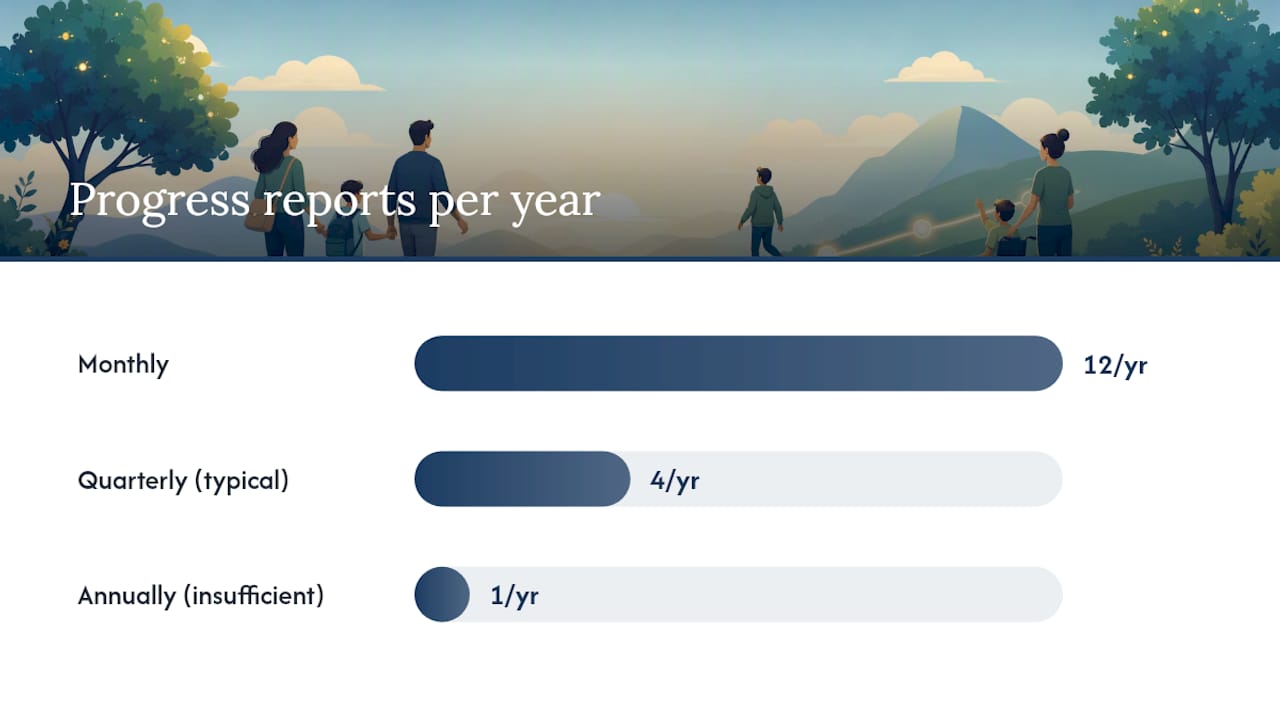
Schools must report progress toward IEP goals at least as often as they report progress to parents of general education students, which for most districts means every quarter alongside report cards. If the IEP says progress will only be checked once a year, that falls short of what most districts practice for general education reporting, and it’s worth asking why.
Progress reports should show a trend, not just a snapshot. A single data point from April tells you almost nothing. A series of monthly scores climbing from 42 to 58 to 65 words per minute tells you the intervention is working, or isn’t.
If a goal reads vague, try these questions at the meeting:
- “What specific assessment or data source will you use to measure this?”
- “What is my child’s current performance on this exact skill, today?”
- “How often will I receive progress updates, and in what format?”
- “What happens if progress reports show no growth by the midyear mark?”
Objectives or benchmarks, when they appear, break a big annual goal into smaller checkpoints along the way. Not every IEP uses them, but when a goal is ambitious or the student is far behind grade level, benchmarks give everyone an earlier warning sign if things stall.
What Should the Services Statement Actually Say?
The services page, sometimes called the service matrix or service grid, is where the IEP gets specific about who does what, how often, and where. This is the section that turns goals into an actual schedule, and it’s one of the easiest places to spot a mismatch between what’s promised and what’s realistic.
Special education services and related services aren’t the same thing, though people mix them up constantly. Specialized instruction means direct teaching in a specific skill area, delivered by a special education teacher, aimed at an IEP goal. Related services support the child’s ability to benefit from that instruction. Speech therapy, occupational therapy, physical therapy, counseling, and transportation are common examples.
The matrix should spell out five things for every single service:
- Frequency: how many sessions per week or month
- Duration: how many minutes per session
- Start and end dates: usually tied to the annual review cycle
- Location: general education classroom, resource room, therapy room, or elsewhere
- Provider: the specific role responsible, such as speech language pathologist or special education teacher
Do the math on total minutes. If a goal targets significant reading growth but the matrix lists only 30 minutes of specialized reading instruction per week, ask whether that’s really enough time to close the gap the PLAAFP describes. Comparing service matrix minutes directly against each goal’s expected pace is one of the fastest ways to catch a plan that looks good on paper but won’t deliver in practice.
Location matters as much as minutes. “Resource room” and “general education classroom, pull-out as needed” are very different placements, and the difference affects how much time your child spends with peers. If the matrix says one thing and your child’s actual schedule looks like something else, that discrepancy belongs on the agenda for your next meeting.
When the matrix reads vague, push for specifics: “Consultation as needed” isn’t a service you can hold anyone accountable for. Ask what “as needed” means in actual sessions per month, and get it written down.
Understanding Accommodations, Modifications, and Assistive Technology
Accommodations and modifications get confused often, but the distinction matters. An accommodation changes how a student accesses material or demonstrates knowledge, without changing what’s being taught or tested. Extended time on tests, preferential seating, and audio versions of textbooks are accommodations. A modification changes what the student is expected to learn, such as a shortened assignment or a different grading scale. Modifications lower the bar; accommodations remove barriers without lowering it.
Assistive technology sits alongside both. Speech-to-text software, communication devices, and text-to-speech tools all fall under this umbrella, and the IEP should name the specific tool or device, not just gesture at “technology as needed.”
Look for these details when reviewing accommodations:
- Where each accommodation applies: classroom only, testing only, or both
- Who is responsible for implementing it, since a vague accommodation with no owner rarely happens consistently
- Whether state and district assessment accommodations match classroom accommodations
- Whether an alternate assessment is being used instead of the standard state test, which is a bigger decision that changes the diploma track in some states
Assessment accommodations deserve a close read on their own. If your child gets extended time in class but the IEP doesn’t list extended time for the state assessment, that’s a gap that could cost real points on test day.
Pro Tip: If accommodations don’t name a specific person or setting, ask “who makes sure this happens every day?” A vague accommodation with no assigned owner tends to quietly disappear by November.
One more distinction worth knowing: if your child doesn’t qualify for an IEP but still needs accommodations, a Section 504 plan under the Rehabilitation Act might apply instead. A 504 plan covers accommodations but not specialized instruction or related services, and it follows different procedural rules than an IEP does.
LRE, Special Factors, and Transition Planning
Least Restrictive Environment, or LRE, describes how much time your child spends learning alongside peers without disabilities. The IEP should state a percentage or a description, something like “80% of the school day in general education.” Compare that number to the service matrix. If LRE says mostly general education but the matrix schedules pull-out services during core subjects for hours at a time, the two sections contradict each other.
Ed alongside participation in nonacademic and extracurricular activities, which the team must also consider. Sports, clubs, and lunch with classmates count, and the IEP should note any supports needed for your child to take part.
Special factors are a required checklist the team must address for every student, regardless of disability category:
- Behavior that impedes learning, requiring a behavior plan or functional behavioral assessment
- Limited English proficiency and language needs
- Blindness or visual impairment, which triggers a Braille instruction discussion
- Deafness or hearing impairment and communication needs
- Assistive technology needs
Transition planning becomes a required part of the IEP starting no later than the IEP in effect when your child turns 16, though many states start earlier. This section should include measurable postsecondary goals covering education, employment, and independent living, plus the specific transition services and courses that will help get there. If your teenager’s IEP has no transition page and they’re approaching 16, that’s a compliance gap worth flagging immediately.
A Step-by-Step Way to Trace Your Concerns Through the Document
Reading an IEP cover to cover rarely works. These documents run 20 to 40 pages, mix legal language with data tables, and bury the parts that matter most to you among sections that don’t apply to your situation. Experienced advocates recommend a different approach entirely: pick your top concerns first, then trace each one through the document like a thread.
Here’s a workflow that works whether you’re prepping solo at the kitchen table or reviewing alongside a co-parent or advocate.
- Name your top one to three concerns before you open the document. Maybe it’s reading fluency, meltdowns during transitions, or slow progress on math facts. Writing these down first keeps you from getting lost in sections that don’t touch your priorities.
- Find each concern in the PLAAFP. Does the present levels section describe this issue with real data, or does it skip past it? If your top concern isn’t mentioned in present levels at all, that’s often the root problem.
- Match the concern to a goal. Every concern named in PLAAFP should connect to a specific, measurable annual goal. If it doesn’t, ask why during the meeting.
- Check the service minutes against that goal. Does the time allotted look realistic for the growth the goal expects? A goal asking for a full grade level of reading growth needs more than 20 minutes a week of support.
- Confirm the monitoring plan. How often will you get updates, and what will those updates measure? Vague answers here mean you won’t know if the plan is working until it’s too late to adjust.
- Repeat for each of your top concerns, then set the rest of the document aside for a second, calmer read.
Annotating as you go speeds this up enormously. Color-coding each of the seven IDEA-required components, one color per section, with margin notes tracking who provided each piece of data, makes inconsistencies jump out fast and gives you clear talking points for the meeting instead of a vague sense that something feels off.
Before the meeting, gather a small stack of supporting material: recent report cards, samples of homework or classwork, outside evaluation results if you have them, and any written communication from teachers about struggles at school. Bring a specific list of who you’d like present, since you can request related service providers attend if their services are being discussed.
| Prep step | What to bring or do | Why it matters |
|---|---|---|
| Review the draft in advance | Ask for the draft IEP 2 to 3 days before the meeting | Reading cold in the room leads to rushed decisions |
| Gather evidence | Report cards, work samples, outside evaluations | Supports specific requests instead of general complaints |
| Write down questions | One page listing exact wording for each concern | Keeps the meeting focused and on time |
| Invite the right people | Request specific service providers if needed | Direct answers beat secondhand summaries |
| Know your exit options | Request an IEP meeting or an independent evaluation if disputes remain | Keeps momentum if the meeting doesn’t resolve everything |
If you leave a meeting with unresolved disagreements, you don’t have to wait until next year. You can request another IEP meeting at any time, and if you disagree with the school’s evaluation, you can request an Independent Educational Evaluation (IEE) at public expense under certain conditions.
Pro Tip: Bring your annotated copy to the meeting, not a clean printout. Seeing your specific notes and questions signals that you’ve done the work, and it keeps the conversation anchored to your actual concerns instead of drifting into generalities.
Your Rights as a Parent on the IEP Team
You’re a full member of the IEP team under IDEA, not a guest. That means you can request the draft ahead of time, ask for the meeting to be rescheduled if the timing doesn’t work, and request changes to any section before signing. Parents should treat the draft as a starting point, not a finished product handed down for approval.
Schools must give you Prior Written Notice whenever they propose or refuse to change your child’s identification, evaluation, placement, or services, explaining the reasoning in writing. Your consent is required before initial special education services begin. If you disagree with something, put it in writing and ask that your concerns be documented in the IEP itself, not just discussed verbally.
A tool like the IEPful meeting plan builder can help organize priorities, generate specific questions, and produce a printable checklist before you walk into the room. It’s built to speed up preparation, not replace your legal right to disagree, request changes, or pursue formal complaints, which run through your state’s department of education.
Why I Tell Parents to Stop Reading Top to Bottom
Most people open an IEP and start on page one, and most people burn out somewhere around page twelve. That’s backwards. The document isn’t written for narrative reading. It’s written to be cross-referenced, and the parents who get the most out of it treat it that way from the start.
My advice: pick your one or two biggest worries, then chase them through the PLAAFP, the goal, the service minutes, and the monitoring plan before you look at anything else. That chain either holds together or it doesn’t, and you’ll know within ten minutes which one it is. I’ve seen a single missing baseline number unravel an entire goals page once someone actually traced it back.
This approach comes from reviewing the same federal framework school teams use every day, not from a single case or a single district’s habits, so it holds up regardless of what template your school happens to use.
— Sam
Prepare Your Meeting in Minutes, Not Hours
Reading the IEP is half the work. Walking into the meeting ready to speak up is the other half, and that’s where a lot of well-prepared parents still stumble under the pressure of the room. A meeting planning tool can build a personalized meeting plan quickly, without requiring an account, turning your concerns into prioritized questions and a printable checklist you can actually use at the table.
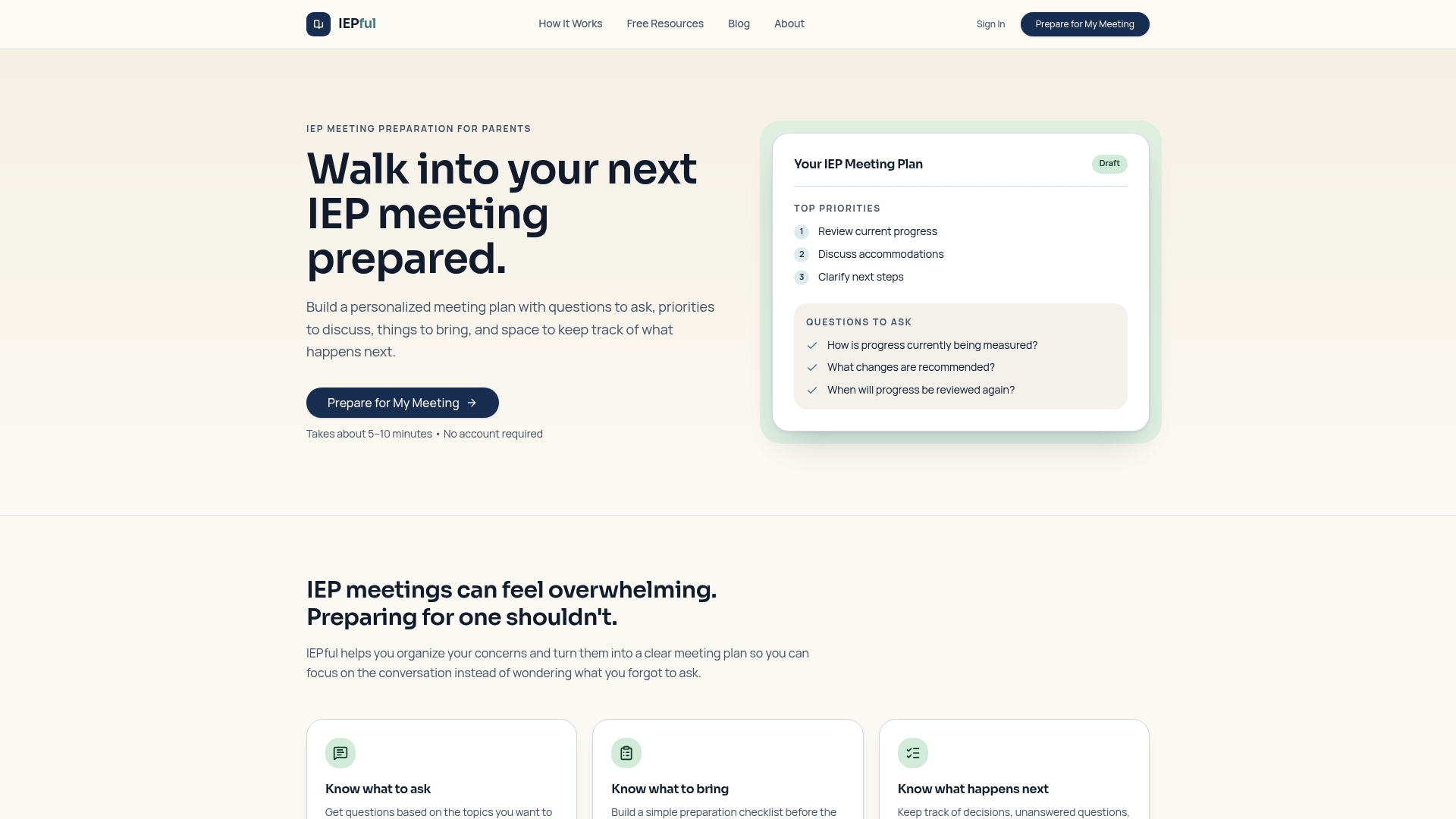
It picks up exactly where this guide leaves off: once you’ve traced your concerns through PLAAFP, goals, and services, Iepful helps you turn those notes into clear talking points and follow-up items you won’t forget once the meeting gets moving. Parents who want a deeper level of organization can also look at the Complete Meeting Pack, which adds more structured tools for tracking requests and outcomes over time. Start building your free meeting plan before your next IEP meeting and walk in with your priorities already on paper.
Where to Read the Actual Law and Guidance
The legal definition of an IEP and its seven required components comes straight from federal regulation, detailed in 34 CFR §300.320 via the Legal Information Institute. For a full walkthrough of parent rights, timelines, and transition requirements, the Department of Education’s parent guide remains the most complete federal resource available. For a shorter reference, Parent Center Hub’s overview breaks down what must appear in the document without the legal density.
This article is general information, not a substitute for advice from a qualified lawyer. Consult a qualified legal professional about your own circumstances before acting on anything here.
Sources
- Individualized education program (Legal Information Institute)
- Ed
- How to read an IEP: 5 things teachers should look for — Understood
- The Short-and-Sweet IEP Overview — Parent Center Hub
FAQ
How do you read an IEP?
Start with the Present Levels (PLAAFP) to understand the baseline, then check that each annual goal ties back to that baseline and includes a measurable target. From there, verify the service matrix lists specific minutes, providers, and locations, and confirm a progress-monitoring schedule exists for every goal.
What are the 13 disability categories under IDEA?
IDEA lists various categories including autism, specific learning disability, speech or language impairment, other health impairment, emotional disturbance, intellectual disability, multiple disabilities, hearing impairment, orthopedic impairment, visual impairment, deaf-blindness, traumatic brain injury, and developmental delay. Eligibility under one of these categories is a separate step from what goals and services the IEP actually provides.
What are the seven required components of an IEP?
Under 34 CFR §300.320, an IEP must include present levels of performance, measurable annual goals, a description of how progress will be monitored, a statement of special education and related services, an explanation of participation with nondisabled peers, participation in state and district assessments, and the dates, frequency, location, and duration of services. All seven should be traceable and consistent with one another.
What does a good IEP look like?
A strong IEP has present levels full of specific numbers and dates, goals with clear baselines and targets that link directly back to those present levels, and a service matrix with realistic minutes matched to the growth each goal expects. Progress monitoring should happen on a regular, stated schedule, not just once a year, and accommodations should name who’s responsible for implementing them.
How can I prepare for an IEP meeting if the document feels overwhelming?
Focus on your top one to three concerns and trace each through the PLAAFP, goals, services, and monitoring sections rather than reading the whole document in order. Tools like the Iepful meeting plan builder can turn that review into a prioritized list of questions and a printable checklist in about five to ten minutes.