Protect Your Child: 4 IEP Steps on FAPE for U.S. Parents

FAPE means a Free Appropriate Public Education under the Individuals with Disabilities Education Act, the federal law that guarantees special education and related services, at public expense, provided in an Individualized Education Program that is reasonably calculated to enable a child to make appropriate progress. It applies to eligible children with disabilities in U.S. public schools. Understanding this one phrase shapes almost every decision your school makes about your child’s education.
TL;DR:
- Schools must provide individualized, ambitious IEP goals that demonstrate meaningful progress, moving beyond minimal benefits established before the Endrew F. decision.
- Related services, accommodations, and program modifications must be tailored to the child’s needs and provided at no cost to ensure access to the general curriculum.
- FAPE does not guarantee specific academic outcomes or funding for private therapies unless the district fails to meet the required standard of free, appropriate education.
- Disputes can be addressed through state complaints, mediation, or due process hearings, with proper documentation supporting the child’s progress and services.
- Preparing for IEP meetings with specific questions and recent data enhances advocacy and helps ensure the child’s needs are thoroughly addressed.
Table of Contents
- What FAPE means under IDEA and how Section 504 fits in
- Primary laws and federal guidance parents should know
- How courts interpret ‘appropriate’: the Endrew F. standard explained
- What schools must provide to meet FAPE
- What FAPE does not guarantee
- If you disagree: procedural safeguards and dispute options
- Preparing for IEP meetings: steps that make a difference
- Historical background and legislative evolution of FAPE
- Examples of services and accommodations commonly provided under FAPE
- FAPE under IDEA versus Section 504: what changes in practice
- IEPful resources parents can use right away
- Sources
- FAQ
What FAPE means under IDEA and how Section 504 fits in
Under the Individuals with Disabilities Education Act, FAPE has several required pieces working together. Special education and related services must be provided at public expense, under public supervision, and without charge to you. They must meet the standards of the state education agency, cover an appropriate education from preschool through secondary school, and be delivered according to a properly developed IEP. IDEA states that FAPE must be made available to every eligible child residing in the state, and the obligation generally begins no later than a child’s third birthday.
Section 504 of the Rehabilitation Act of 1973 also guarantees FAPE, but through a civil rights lens rather than IDEA’s education framework. A Department of Education fact sheet notes that implementing an IDEA-compliant IEP is one accepted way to satisfy Section 504’s FAPE requirement. Most children remain covered from age 3 through 21, and districts have an ongoing “child find” duty to identify and evaluate children who may need services, even before a parent asks.
Primary laws and federal guidance parents should know
Two regulatory citations anchor most FAPE discussions. 34 CFR §300.17 defines FAPE itself, while §300.101 addresses when the obligation to provide it applies. The U.S. Department of Education also publishes guidance that translates these rules into plain language, including its Q&A on Endrew F., which walks through how the Supreme Court’s decision changed what schools must show.
These are federal floors, not ceilings. States and individual districts can set their own standards, timelines, and forms that go beyond what IDEA requires, so a rule that applies in one state may not describe your district exactly. When something in your child’s IEP process feels off, it helps to check your state’s department of education website alongside these federal sources rather than assuming national guidance covers every local detail.
How courts interpret ‘appropriate’: the Endrew F. standard explained
For years, some courts accepted a low bar for FAPE, sometimes called the “de minimis” standard, meaning any measurable benefit was enough. The Supreme Court’s Endrew F. v. Douglas County School District decision changed that. According to the Department of Education’s Q&A on the ruling, an IEP must be reasonably calculated to enable a child to make progress that is appropriate in light of that child’s own circumstances, a standard well above minimal or trivial gains.
In practice, this means IEP goals should be individualized and ambitious given what your child can achieve, not generic or copy-pasted from a template. At meetings, you can reasonably ask the team to show measurable annual goals, explain how progress will be tracked, and describe what happens if your child isn’t meeting expectations. Vague language like “will improve” without a way to measure it is a signal to ask more questions.
What schools must provide to meet FAPE
FAPE isn’t just a philosophy; it translates into specific services and program features. Related services, as defined in 34 CFR §300.34, cover a wide range of supports a child might need to benefit from special education.
- Specially designed instruction tailored to the child’s needs, plus related services such as speech-language pathology, audiology, counseling, occupational or physical therapy, transportation, and school health services.
- Supplementary aids and services, program modifications, and classroom accommodations that let the child access the general curriculum.
- Placement decisions that follow the Least Restrictive Environment principle, meaning children are educated with nondisabled peers to the maximum extent appropriate, with a continuum of placement options available when needed.
- All services written into the IEP at no cost to parents, since FAPE requires these supports be provided at public expense.
What FAPE does not guarantee
FAPE sets a process and a standard of effort, not a promise of a particular result. Schools are not required to guarantee a specific grade level, diploma type, or outcome, nor are they locked into one instructional method if another reasonable approach also supports progress. Districts generally do not have to fund private therapies or private school placement unless a hearing officer or court later finds the district failed to provide FAPE, a determination described in IDEA’s private placement regulation. Fees charged equally to all students, like some field trip costs, are treated differently from services an IEP requires, which must remain free to you.
If you disagree: procedural safeguards and dispute options
When you believe your child isn’t receiving FAPE, IDEA gives you several formal paths, each with its own process and timeline.
- File a state complaint with your state education agency, which investigates alleged violations of IDEA requirements.
- Request mediation, a voluntary process where a neutral third party helps you and the district reach an agreement.
- File a due process complaint, which triggers formal procedural safeguards, including a resolution meeting the district must generally hold within 15 days of the filing, according to federal procedural safeguards guidance.
Hearing officers focus mostly on substance. That same guidance explains that procedural errors lead to a finding of denied FAPE only when they significantly interfered with your participation, your child’s right to FAPE, or caused a real loss of educational benefit, not simply because paperwork was imperfect.
Pro Tip: Keep a dedicated folder, physical or digital, with every IEP draft, evaluation report, email exchange, and progress report; these records become essential evidence if a dispute ever moves to mediation or a hearing.
Preparing for IEP meetings: steps that make a difference
Good preparation starts before you sit down at the table. Review your child’s present levels of performance and gather recent progress data, report cards, and any outside evaluations so you can speak from specifics rather than impressions.
- List two or three priorities you want addressed, since trying to cover everything at once tends to dilute the conversation.
- Draft questions tied to measurable goals: what exactly will be measured, how often, and who is responsible for tracking it.
- Ask for clear progress-monitoring language in the IEP itself, and know that you can request a review meeting anytime, not just at the annual mark.
- Communicate concerns in writing beforehand when possible, so the team has time to prepare a thoughtful response.
Pro Tip: Send a short email summarizing your top concerns a few days before the meeting; it gives the team time to gather relevant data and often shortens the meeting itself.
IEPful’s free Plan Builder helps you organize these priorities and generate meeting-ready questions in about 5 to 10 minutes without creating an account. An optional Complete Meeting Pack adds expanded questions, printable materials, and follow-up tracking tools.
Historical background and legislative evolution of FAPE
FAPE’s roots trace back to the mid-1970s, when Congress passed the Education for All Handicapped Children Act of 1975, the law that eventually became IDEA. Before this legislation, many children with disabilities were routinely excluded from public schools entirely or placed in settings with little accountability for actual learning. The original law established the basic architecture still in place today: a right to a free appropriate public education, individualized planning through what we now call the IEP, and procedural protections for families.
Congress reauthorized and renamed the law several times, most notably in 1990 when it became the Individuals with Disabilities Education Act, and again through amendments in 1997 and 2004 that strengthened procedural safeguards and aligned special education more closely with general education accountability. Section 504 of the Rehabilitation Act, passed in 1973, predates IDEA and established a broader civil rights foundation prohibiting disability discrimination in any program receiving federal funding, including public schools.
The legal meaning of “appropriate” also evolved through litigation. For decades, courts interpreted the standard loosely, and it took the Supreme Court’s 2017 decision in Endrew F. to clarify that IEPs must aim for meaningful, individualized progress rather than trivial benefit, a case discussed further in the Department of Education’s Q&A. Each of these shifts, legislative and judicial, pushed FAPE from a vague promise toward a more concrete, enforceable standard.

Examples of services and accommodations commonly provided under FAPE
FAPE looks different for every child because it’s built around individual need, but certain categories of support appear across many IEPs. Related services often include speech-language therapy for communication delays, occupational or physical therapy for motor skill development, counseling for social-emotional needs, and school health services for children with medical conditions that affect their school day. Transportation is also considered a related service when a child’s disability requires specialized transport to and from school.
Accommodations tend to focus on access rather than content, things like extended time on tests, preferential seating, use of a calculator or text-to-speech software, breaks during long tasks, or a modified schedule. Program modifications go a step further and may adjust the actual curriculum expectations, such as shortened assignments or alternate grading criteria, for students whose disabilities significantly affect their ability to meet standard grade-level work.
Supplementary aids and services round out the picture: a classroom aide, assistive technology like a communication device, modified materials, or behavior support plans. All of these must connect back to the child’s documented needs and goals rather than existing as a generic list, and all must be delivered at no cost to you when they’re written into the IEP.

FAPE under IDEA versus Section 504: what changes in practice
Both laws promise FAPE, but they work differently once you’re sitting in a meeting. IDEA requires an Individualized Education Program with detailed present levels of performance, measurable annual goals, and specific services, evaluated periodically and revised when a child isn’t progressing as expected. Section 504 typically results in a simpler plan, often just accommodations, without the same formal goal-writing or specialized instruction requirements.
Eligibility also differs. IDEA covers 13 specific disability categories and requires that the disability affect educational performance enough to need specially designed instruction. Section 504 has a broader definition of disability and can cover students who need accommodations but don’t require specialized instruction, making it a relevant option when a student doesn’t qualify under IDEA, as the Department of Education’s Section 504 resource guide explains.
Procedural safeguards differ too. IDEA’s dispute process, including state complaints, mediation, and due process hearings, is more detailed than Section 504’s, which generally relies on a district’s own grievance procedure and Office for Civil Rights complaints. For families navigating both, it helps to know which law is actually governing your child’s plan, since the paperwork, review cycle, and appeal options aren’t identical.
IEPful resources parents can use right away
Preparing for an IEP meeting is easier with a plan you’ve already thought through, not a blank notepad and a hope that you’ll remember everything. IEPful’s free Plan Builder walks you through your priorities and generates useful, specific questions in about 5 to 10 minutes, no account required.
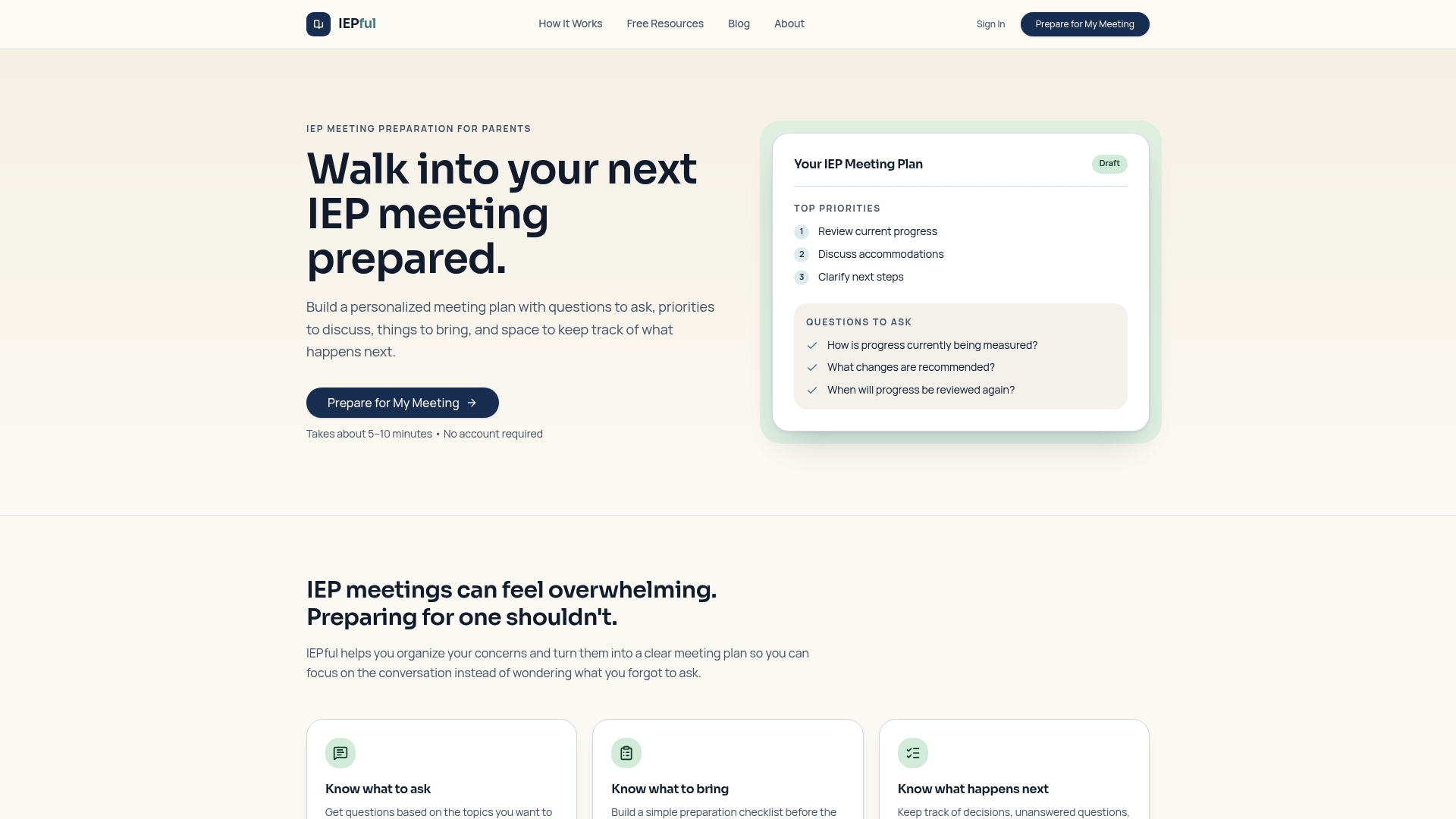
For families who want more structure, an optional Complete Meeting Pack adds expanded questions, printable materials, note-taking pages, and follow-up tracking so nothing gets lost after the meeting ends. Learn more about how IEPful’s process works or start building your plan at Iepful. These tools are meeting-preparation aids, not legal advice.
This article is general information, not a substitute for advice from a qualified lawyer. Consult a qualified legal professional about your own circumstances before acting on anything here.
FAQ
What is considered a violation of FAPE?
A FAPE violation generally happens when a district fails to provide the special education and related services an eligible child needs to make appropriate progress, or when procedural failures significantly limit parental participation or educational benefit. Minor paperwork errors alone usually don’t count, according to federal procedural safeguards guidance; the focus is on real impact to the child or family.
Which federal law requires FAPE?
The Individuals with Disabilities Education Act requires FAPE for eligible children with disabilities, and Section 504 of the Rehabilitation Act of 1973 requires it as well through a civil rights framework. Both laws overlap, and many schools use an IDEA-compliant IEP to satisfy Section 504’s requirement too.
What is the difference between FAPE and IEP?
FAPE is the legal standard, a free appropriate public education that every eligible child is entitled to receive. The IEP, or Individualized Education Program, is the specific written document and plan that spells out how a school will deliver FAPE to that particular child.
When did FAPE become law?
The core FAPE requirement traces back to the Education for All Handicapped Children Act of 1975, which later evolved into the Individuals with Disabilities Education Act. Section 504 of the Rehabilitation Act, passed in 1973, also established a FAPE requirement slightly earlier, through civil rights law rather than education law.
Recommended
Made with BabyLoveGrowth to get found by Claude
IEPful provides educational planning and organization information, not legal, medical, or individualized professional advice. Requirements and procedures can vary; verify current information with official sources.