5 IEP Phrases U.S. Parents Can Use for Accommodations vs Modifications

Accommodations change how a student accesses learning; modifications change what a student is expected to learn. Both can appear in an IEP or 504 plan, and the IEP team, including you, decides which one fits your child’s needs. Getting this distinction right shapes classroom expectations, testing options, and even graduation requirements down the road.
TL;DR:
- Most accommodations, like extended time or audiobooks, do not affect high school diploma eligibility, but some state-specific rules may require state-approved options.
- Modifications such as reducing test questions or replacing curriculum content can impact transcripts and diploma qualification, requiring careful review before approval.
- The IEP team, including parents, must specify the exact frequency, location, and duration of each service or support to ensure clear implementation.
- Requesting written amendments for all services and supports prevents miscommunication and solidifies commitments during the IEP process.
- Using a structured meeting plan helps parents prioritize functional needs, generate targeted questions, and secure detailed, actionable support descriptions in the IEP.
Table of Contents
- Accommodations vs Modifications: The Core Difference
- What Do Accommodations and Modifications Look Like in Practice?
- How Do These Show Up in IEPs and 504 Plans?
- How Do Testing Accommodations Affect Diplomas?
- Who Decides, and How Do You Keep the Meeting on Track?
- Meeting-Prep Checklist Parents Can Use
- Prepare for Your Next IEP Meeting With a Clear Plan
- Sources
- FAQ
Accommodations vs Modifications: The Core Difference
An accommodation changes the “how” without touching the “what.” Your child still learns the same grade-level material and takes the same tests, just with a different route to get there. Common examples include audiobooks instead of print text, extended time on assignments, or a quiet room for tests. The learning target stays fixed; only the path changes.
A modification changes the actual curriculum or expectation. That might mean a shortened reading list, fewer math problems covering simpler concepts, or grading against a different standard than same-grade peers. The Washington Office of the Education Ombuds frames it plainly: accommodations help a student meet the same standards, while modifications alter what’s being taught or assessed.
That difference carries weight beyond the classroom. Modified coursework can affect transcripts, credit toward a standard diploma, and how colleges or employers read students’ academic records later. Accommodations generally don’t touch any of that, since the student is still working toward the same benchmarks as classmates. Neither term is legally rigid. Terminology varies by state and district, so what one school calls a modification, another might file under a different label entirely. Documenting the actual functional need, rather than fighting over which word goes in the box, tends to serve students better.
What Do Accommodations and Modifications Look Like in Practice?
Seeing these side by side in real classroom situations makes the distinction easier to spot and easier to request.
Classroom accommodation examples:
- Text-to-speech software or audiobooks for reading assignments
- Extended time to finish classwork or homework
- Preferential seating near the teacher or away from distractions
- Notes or slides provided in advance
Assessment accommodation examples:
- Testing in a separate, quieter setting
- Extended time on exams
- Answers recorded verbally instead of in writing
- Breaks built into longer testing sessions
Modification examples:
- A reduced number of test questions covering only core concepts
- Alternate assignments graded on a different scale than the general class
- Grade-level curriculum swapped for functional or below-grade content
Some supports fall outside academics entirely, like a paraprofessional aide during PE, adapted equipment in art class, or modified expectations on a field trip. If you’re preparing for a meeting, try phrasing your ask this way: “My daughter can access the same science curriculum with text-to-speech and significantly more time on written tests.” That’s specific enough for the team to act on.
How Do These Show Up in IEPs and 504 Plans?
Federal regulations spell out exactly what belongs in an IEP. Under Sec. 300.320 of the IDEA regulations, the document must state special education and related services, supplementary aids and services, program modifications or supports for school personnel, and any accommodations needed for state and district assessments. Just as important, it must list the projected start date and the frequency, location, and duration of each service.

A 504 plan works differently. It typically documents accommodations only, since 504 plans don’t provide specialized instruction the way IEPs do. If your child needs modified curriculum content, not just modified access, an IEP is usually the appropriate vehicle rather than a 504 plan.
When you review a draft IEP, check for three things: does each accommodation or modification name a specific frequency (daily, per test, per unit)? Does it name a location (general education classroom, resource room, testing center)? Does it name a duration (for the school year, through a specific date)? The Parent Center Hub notes that supplementary aids and supports for school personnel, like paraprofessional training, should be spelled out in writing too, not just implied.
How Do Testing Accommodations Affect Diplomas?
Most accommodations, like extended time or a separate setting, leave standardized test scores fully valid, meaning your child’s results count the same as any other student’s. But not every accommodation qualifies for every test. Under 34 C.F.R. §300.160, some states require that only state-approved accommodations be used to preserve score validity, so it’s worth asking directly whether a requested accommodation meets that standard before agreeing to it.
Alternate assessments are a different matter. These replace the standard test entirely and are typically reserved for students with the most significant cognitive disabilities. Choosing an alternate assessment can affect eligibility for a standard diploma in some states. Before agreeing to one, ask the team: Is this accommodation state-approved for testing? Will this assessment path affect diploma eligibility? What does this look like for high school graduation requirements?
Who Decides, and How Do You Keep the Meeting on Track?
The IEP team makes these decisions together, and that team includes you. Under IDEA, the team typically includes at least one general education teacher, a special education teacher, a school representative who can commit resources, someone who can interpret evaluation results, and the parent. Your input carries real weight, not just a formality.
Once the IEP lists specific services and supports, the school has to provide them as written. A recent OSEP policy letter confirms that a school cannot unilaterally reduce the amount of listed services without going back to the team, parent included.
To keep meetings productive, push for measurable language over vague promises. Ask that frequency, location, and duration be written into every accommodation or modification. Request follow-up dates for reviewing whether something is actually working. And if the team focuses too much on labels, redirect toward the functional barrier you’re trying to solve.

Meeting-Prep Checklist Parents Can Use
Walking into an IEP meeting prepared changes the entire tone of the conversation. Here’s a sequence that works:
- Write down your child’s top two or three functional needs in plain language.
- Gather recent evidence: report cards, teacher notes, outside evaluations, work samples.
- Draft the exact accommodation or modification language you want to propose, including frequency and setting.
- Prepare specific questions to confirm the team’s plan matches what gets written into the document.
- Ask for a follow-up date to review whether the supports are working as intended.
Pro Tip: Always ask for IEP amendments in writing, and request the frequency, location, and duration of each service before you leave the meeting. Verbal agreements tend to fade; written ones don’t.
A structured planner can speed up steps one through four considerably. IEPful’s free Build Your IEP Meeting Plan tool auto-generates a prioritized list of questions and a printable checklist based on what you enter, so you’re not starting from a blank page the night before your meeting.
Prepare for Your Next IEP Meeting With a Clear Plan
Most parents walk into an IEP meeting with a stack of paperwork and no clear sense of what to ask first. A free plan builder can help by turning your child’s needs into a prioritized list of questions and a printable checklist quickly, without requiring an account.
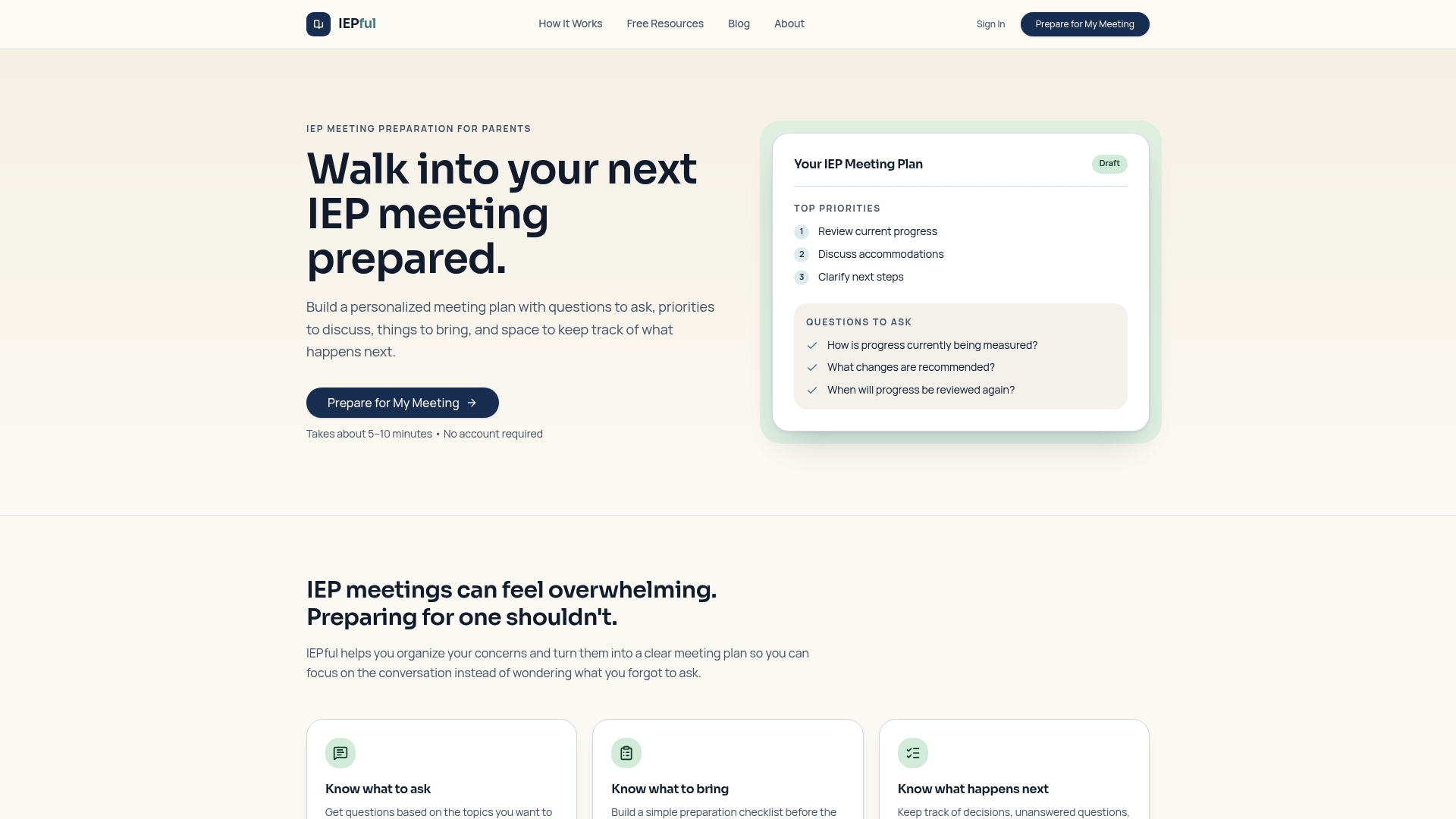
The free plan builder helps you organize priorities before the meeting even starts, generate questions specific to your child’s situation, and leave with a checklist you can hand to the team. If you want more, the Complete Meeting Pack adds expanded questions, printable materials, note-taking tools, and follow-up tracking for a one-time $19 fee. Either way, the goal is the same: help you walk out with frequency, location, and duration written into the IEP, not left as a verbal promise. Start by building your meeting plan today, before your next meeting gets scheduled.
Sources
For the federal rules on what an IEP must contain, read Sec. 300.320 of the IDEA regulations and the assessment accommodation rules under §300.160. The Parent Center Hub breaks down IEP contents in plainer language, and the NCEO brief on accommodations and modifications offers a useful side-by-side comparison.
- Sec. 300.320 Definition of individualized education program — IDEA regs
- What are accommodations and modifications? — OEO (Washington)
- Contents of the IEP — Parent Center Hub
FAQ
What Are Some Examples of Modifications?
Modifications include a reduced number of test questions, alternate assignments graded on a different scale, or grade-level curriculum replaced with functional or below-grade content. Unlike accommodations, these change what the student is actually taught or tested on, not just how they access it.
Is an IEP a Modification or an Accommodation?
An IEP can include both. It’s a legal document under IDEA that lists whichever combination of services, accommodations, and modifications the team determines your child needs, along with the frequency, location, and duration of each.
What Are the Four Types of Accommodations?
Accommodations are commonly grouped into presentation (how material is delivered, like audiobooks), response (how a student answers, like verbal responses), setting (where work happens, like a quiet room), and timing/scheduling (extended time or breaks). Not every school uses these exact category names, so ask how your district organizes its accommodation options.
Is a 504 Plan for Accommodations or Modifications?
A 504 plan typically covers accommodations rather than modifications, since it doesn’t include specialized instruction. If your child needs changes to curriculum content or grade-level expectations, an IEP is usually the more appropriate document.
What Should I Ask For if I’m Not Sure Whether My Child Needs an Accommodation or a Modification?
Start by naming the specific barrier your child faces, rather than picking a label first. IEPful’s free meeting plan can help you organize that functional need into questions the IEP team can act on directly.
Created with BabyLoveGrowth to rank on Google
IEPful provides educational planning and organization information, not legal, medical, or individualized professional advice. Requirements and procedures can vary; verify current information with official sources.